Churn, Learn, Love and Earn

This repost fits perfectly with a series of posts that Doug Borwick and Amelia Northrup-Simpson are featuring this week on the relationship between engagement and marketing.

FILLING THE EMPTY SEATS FIRST II

In my first post in this series we talked about the last seat sold, the empty seat next to it, and what the person who showed up and the one who didn’t quite make it have in common. We in the arts talk a lot about new audiences, but we seldom take time to focus on exactly who these people are, how much they care about us, or why any of them might want to buy what we’re trying to sell.

And at the same time we complain bitterly about churn – the tendency among contemporary audiences to sample our wares without becoming regular or dependable customers. Having built our institutions on audiences of loyal, stable, committed patrons, we tend to view churn as a problem that needs to be overcome and we’re reluctant to accept the fact that churn and new audiences are essentially the same thing.

Audience TiersI used this diagram in my book to describe the place where churn and new audiences meet. The inner circle is the arts organization, of course, and everyone professionally associated with it. The first ring is the core support system of members, donors, subscribers and loyal patrons. The second ring is the somewhat less avid, but nonetheless vital population of regular patrons. And the third is the fickle, least avid, least committed audience of frustrating churners. So far, it’s a picture of the audience segments I described in my last post.

But the ring I’m most interested in is the outermost ring – the thin, light gray ring just beyond the third that identifies the relationship between old and new audiences. The folks who occupy this adjacent space are more likely than others to give us a try, but for some reason they haven’t yet stepped across the boundary to become part of the active third ring. Nothing, as far as I’m concerned, is more important than understanding how to motivate these people to cross that line.

I chose to illustrate new audiences this way for four reasons:

1. It is imperative that we begin thinking about audiences in terms of relative avidity – the further you move from the center, the less avid the customer’s interest in the product. New audiences who inhabit the fourth ring are even less avid than our third ring churners, but compared to the rest of humanity, they’re the only people out there who are likely to participate. This places them in a very specific position relative to our existing communities of customers.

2. The closeness of new audiences tells us exactly where to look for them. A lot of arts professionals dream of ideal but as yet untapped new audiences that look and act just like our super-avid base – but who exist in some mysterious realm that we haven’t yet figured out how to contact. Realistic marketers, meanwhile, know that new audiences lie just beyond the ragged, chaotic fringes of our universe of tepid dabblers.

3. Everything we need to know about motivating the fourth ring, we can learn from the third ring. Those who occupy the churn zone have the most in common with those who lie just beyond its boundaries so the more we know about churners and the more actively we use that knowledge to persuade new audiences, the more newcomers we’re likely to pull into the fold.

4. Our job as arts professionals is to persuade everyone within our four-ring universe to move toward the center. If we direct our persuasive energies to the outermost ring, it will naturally influence the inner three rings and draw everyone within our sphere of influence closer. But if we apply our persuasive energies only to the first two rings, which is what most of us do now, the third and fourth rings will remain uncommitted and elusive.

The lesson in all of this is that we have to love the churn. We have to create as much of it as we can, we have to learn everything it can teach us, we have to use what we learn to forge stronger bonds with uncommitted churners, and we have to apply what we learn to unpersuaded outsiders so we can lure more of them into the zone.

Or to put it in community engagement terms, we have to know and love the folks in – and just beyond – the churn zone as well as we know and love the folks in the super-avid base. Then we have to relate to them in a manner that is as personal, relevant and meaningful as the way we’ve been relating to avid arts lovers for the last fifty years.

I know it’s counterintuitive. No serious arts professional wants to believe that our future is dependent on investing in people who don’t currently care all that much about what we do, but it is. Our job now is to convince them we’re worth caring about – and then give them a damned good reason to continue caring once they’ve passed thorough our doors.

Churn, learn, love and earn.

New Audiences Are Like Fairies

When arts professionals use the phrase “new audiences” I like to ask them who they’re referring to, and the response usually goes like this: “You know, younger and more culturally diverse.” It’s an easy picture to conjure up – like a photo in a UCLA recruitment brochure – but press a little harder and you’ll find that most arts pros don’t have a clue who they’re talking about.

I once asked the executive leader of a top American opera company who these younger, more culturally diverse people were and he said, “I don’t know who they are, I just know they’re out there and we’re not doing enough to reach them.” He spoke hopefully, but wistfully, as if he were talking about leprechauns or fairies.

cott-fairy1The problem with talking about ‘new audiences’ in a marketing context is that new audiences don’t exist. Audiences are comprised of individual human beings who don’t become audiences until their butts are in the seats and the lights start to dim. If we want to form new audiences, we have to focus on real, live, individual human beings, and we can’t focus on real, live, individual human beings if we’re dreaming about populations of mythical sprites who exist only in fairy tales.

If you use the phrase ‘new audiences’ to describe the people you’d like to see filling the empty seats in your venue, and you can’t identify exactly who those people are and how they relate to your organization, you are virtually guaranteeing that those seats will remain un-filled. It is impossible to market to people you don’t know.

But if you’re actively engaged in the process of identifying new customers, learning about their needs and desires, and convincing them that your events will satisfy their yearnings, your audiences will begin to grow again.

Here’s some practical advice for arts professionals who want to sell more tickets. Stop talking about audiences and start talking about individual members of your community who can be known, understood and persuaded to buy tickets. The more specific you are in identifying them, and the more thorough you are in learning about their lives, the easier it will be to turn them into customers.

Audiences don’t buy tickets; individual decision makers buy tickets.

There’s a special magic that happens when a room full of individuals becomes an audience. But that magic will never happen if we haven’t bothered to figure out which individuals we intend to have filling the room.

Two Ways To Design A Classical Music Brochure

Here’s one way to design a classical music sales brochure based on a survey of season brochures from America’s top orchestras:

  1. Use a cover image that appeals to industry insiders (i.e. your conductor)
  2. Fill inside pages with photos of artists, instruments, venue, etc.
  3. Use copy that mixes overblown boasting with condescending history lessons
  4. Be relentlessly self-centered, self-important and self-congratulatory
  5. Include a picture of an ethnic child at an education event

Here’s another way to design a classical music sales brochure based on essential sales principles:

  1. Use a cover image that motivates new customers to read the brochure
  2. Fill inside pages with images of customers enjoying themselves at concerts
  3. Describe in natural language how the product will satisfy customers’ desires
  4. Be relentlessly customer-centered
  5. Use pictures of ethnic children only if you’re trying to sell tickets to ethnic children

A brochure is a sales tool. Good sales tools are about making customers happy. But somewhere along the way classical music industry leaders decided that sales tools were rsz_1unnamed-2about making themselves happy. “Yay. We get to publish a brochure once a year that tells the world how wonderful and important we are, and then send it to thousands of people who, if they think we’re as wonderful as we think we are, will pay us to make art.”

Audiences for classical concert music have been diminishing steadily for decades. The best way to reverse this process is to stop doing self-centered promotion and start doing audience-centered sales. But this requires humility and a willingness to make customers a top priority, which – after so many years of using marketing materials to kiss their own asses – is something classical music administrators may never be able to do.

Why Amazon is Soaring and Traditional Arts Organizations are Sinking

I read a fascinating NY Times article on Sunday about the work culture at Amazon. It directed me to a list of “Leadership Principles” the company distributes to new employees and publishes on its website.

Here’s Amazon’s first principle of leadership:

CUSTOMER OBSESSION – Leaders start with the customer and work backwards. They work vigorously to earn and keep customer trust. Although leaders pay attention to competitors, they obsess over customers.

There’s nothing unusual about a successful business saying it makes customers a top priority, but what struck me was how different this is from the arts, where leaders never obsess about customers, and where leaders would never dream of starting with the customer and working backwards. In the arts, we start with ourselves and work back to ourselves. Customers are a priority only to the extent that they’re willing to be caught up in this loop.

I wouldn’t recommend adopting Amazon’s management approach, necessarily; the article makes it sound pretty scary. But I can’t help wondering what would happen if leaders of failing arts organizations started obsessing about customers for a change – especially the new ones they’re going to need to keep their organizations alive.

Where I Spent $50 in Boston (Not at the MFA)

Had I done my homework, I’d have learned in advance about the Museum of a Fine Arts’ exorbitant admission fee and saved a trip over there.

My husband and I were in Boston for the first time in many years and thought we’d pop in for a brief visit as part of our day’s adventure. Once in the lobby, though, we discovered that our museum visit would cost $50.

I asked the fellow who greeted us if the fee was suggested or mandatory, and he told us to come back on Wednesday at 4:00 pm when we could pay whatever we wanted (this was Friday). I knew he was just a low-level staffer so I said, politely, that we were in town for a few hours and couldn’t commit to a long enough visit to make it worthwhile. He cocked his head and shrugged his shoulders in a way that said, “We’re far too important to care if you stay or go.”

A nice security guard did let us slip in to use the restroom, though, so our trip to the MFA wasn’t a total loss.

With more time to visit old haunts, we ended up having an exceptional day in Boston where we treated ourselves to a lovely lunch with a nice bottle of wine, which we used to toast the museum and its thoughtful security staff.

<><><>

As a long-time cultural tourism professional, I’ve paid close attention to the chronic decline in museum attendance over the last twenty years, but mostly from an abstract, aggregate perspective. This weekend I came face-to-face with the choices potential museum goers must make when they assess the relative value of their leisure options: Nice lunch out in an appealing destination, or a visit to the local museum.

I can see why more and more of them are choosing lunch.

3 Questions Union Musicians Should Ask About Marketing

If you’re a classical musician who has studied hard, practiced endless hours and earned significant professional expertise, and the nonprofit organization you perform for says it can’t sell enough tickets to keep you gainfully employed, you have right to know what “can’t” means.

Sadly, what it often means is, “We’ve been selling the same thing the same way to the same people for several decades and they’re not buying anymore.” So when arts leaders say “can’t,” what they may actually be saying is “don’t know how to” and that’s an entirely different argument. Not knowing how to sell tickets is a dubious excuse for curtailing artists’ pay.

If you’re faced with this situation and you’re interested in learning why your employer “can’t” sell enough tickets, here are three questions you might want to ask:

  • Who is making the marketing decisions for this organization?
  • Where did this person study marketing?
  • Where did this person earn his or her professional marketing expertise?

Responsibility – In most organizations, final marketing decisions are made by the chief executive, although artistic directors often have considerable influence. In organizations with weak leaders or poorly defined leadership structures, board members and major donors can have significant influence on marketing decisions. And in some organizations, marketing decisions are arrived at by consensus among staff, designers, artists and executives without without the guidance of an authoritative expert. If your organization says it “can’t” sell enough tickets, it may be useful to identify exactly who is responsible for that incapacity.

Scholarship – Like classical music, marketing is a profession that is complex and difficult to master. Good marketers can study for years to acquire the necessary theoretical basis for honing their skills, and they continually refresh their knowledge through professional development, ongoing practice and high stakes performance. In the arts, meanwhile, you’d be hard-pressedBoy raising hand to find executive decision makers with academic backgrounds in marketing – or significant professional training for that matter – even though their positions call for them to make life and death marketing decisions on a regular basis. If the executive leader is asking you to sacrifice because she can’t sell enough tickets, and she’s the one making the final marketing decisions, it’s perfectly reasonable to ask if she has the necessary education.

Professional Expertise – Classical musicians earn their positions through hard work in rigorous professional settings. Many perform under the finest and most demanding conductors in the industry. The classical music world expects an exceedingly high level of professionalism and artistry from its musicians, and the best – who work for large nonprofit arts institutions – enjoy status at the very pinnacle of their art form. But marketing in these nonprofit institutions is usually a quasi-professional affair that’s governed by amateurs. Arts marketers take their cues not from the marketing profession at large, but rather from insular, self-centered nonprofit traditions and leaders who have limited professional marketing expertise. You won’t find marketers who’ve risen to the top of the marketing profession in the arts; the standards are too low and the people they report to, when it comes to marketing, are underprepared to lead. If you’re being told that your organization can’t sell enough tickets, and the person who makes the ultimate marketing decisions learned what he knows on his way up through the nonprofit arts – which is a terrible place to learn marketing – you might want to ask for an in-depth, external, professional examination of what the word “can’t” actually means.

In past months I’ve written about amateur marketing at the Atlanta Symphony Orchestra, Minnesota Orchestra, San Diego Opera, Nashville Symphony, Vancouver Opera, Hartford Symphony OrchestraPittsburgh Symphony Orchestra, Philadelphia Orchestra and various other organizations that made headlines for financial difficulties. And in recent weeks we’ve been reading about continuing woes in Pittsburgh, Fort Worth and other communities. The link between amateur marketing and shrinking audiences is becoming clear enough to cast doubt on leaders who say they can’t afford to fully employ professional artists when they refuse to employ professional marketing practices.

Understanding how the lack of sophisticated marketing influences ticket sales – and thus the industry’s ability to support professional artists – won’t necessarily win labor disputes; amateur marketing traditions are too deeply woven into classical music industry culture. But refusing to accept the word “can’t” from leaders who lack the education, experience and expertise to defend such a claim may provide useful leverage.

You studied and worked hard to make it to the top of your profession. There’s nothing wrong with asking the people who sell the tickets to be as well prepared to do their jobs as you are to do yours.

Things Hartford Symphony and Pittsburgh Symphony Have in Common

Today I read that the venerable Pittsburgh Symphony is suffering a precipitous drop in ticket sales for their classical concert series. So I went to their marketing materials to look for signs of trouble, and there I found this brochure.

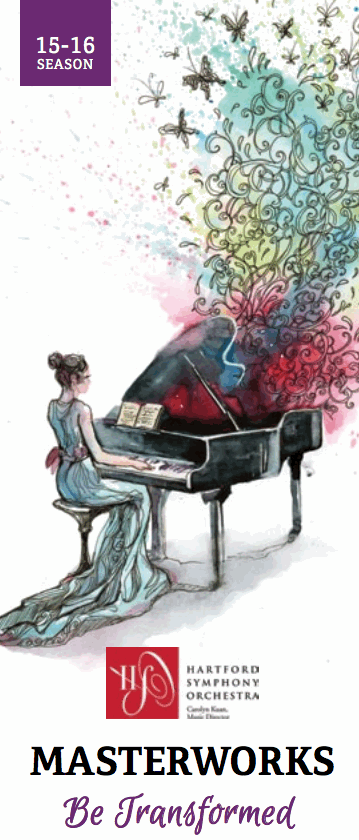
What’s most striking about this sales collateral is its startling resemblance to Hartford Symphony’s brochure. Check it out:

Pittsburgh ArtHartford Art

Two orchestras in the news for declining ticket sales and both chose images of women playing instruments with blobs of paint coming out of them. What are the odds? Clearly, these marketers have tapped into some universal longings that transcend geography. People in Pittsburgh and in Hartford, it would appear, have a burning hunger for women playing instruments with artsy blobs of paint coming out of them.

I would love to have been in those focus groups when young, culturally diverse respondents began talking about their pent up longings for women playing instruments that churn out paint blobs. How fortunate these marketers must have been to have gotten such rich data that gave them such clear direction.

And look at those tag lines. In Hartford, the focus group participants said they had a yearning to be transformed, while in Pittsburgh, they expressed a poetic desire for art that is somehow also play.

“When I look for ways to spend leisure time and money, I respond to abstract, artful imagery that symbolizes my deep-seated desire to morph into a different plane of reality through some sort of mystical process that includes young female musicians, musical instruments, colorful bursts of paint and an eventual transformation into something light and carefree like a butterfly.”

“When my friends and I plan our social outings, we give careful consideration to the complex, semantic interrelationships of art and play and we’re just nuts for poetry so when someone uses clever double entendres that combine these two interests, we jump at the opportunity to buy what they have to sell.”

It’s fascinating to think that new audiences in these cities would have expressed yearnings that come so close to matching the artsy images and cutesy phrases that out-of-touch arts administrators like to put in their classical music brochures.

The focus group research that I’m familiar with, meanwhile, tends to reveal more concrete desires. Rather than talking about abstract metaphorical yearnings, people talk about having a good time with friends or family, seeking entertainment that’s memorable and enriching, enjoying food, drink and art, doing something special, etc. And since motivating these people is a process of leveraging their desires, effective strategic messaging usually involves reflecting these desires and demonstrating how they can be satisfied by purchasing the product. You know, like showing people having a great time enjoying one another’s company at a concert.

I’m not privy to the research that the folks in Hartford or Pittsburgh did to understand what motivates new audiences to buy classical concert tickets, but I can’t help thinking there are young, culturally diverse people in those markets who would be better motivated to participate if they saw themselves and their actual, stated personal yearnings reflected – and satisfied – in local orchestra marketing materials.

Hartford Symphony Fails “Gal-in-a-Starbucks” Test

I read yesterday that Hartford Symphony was having financial difficulties:

“The orchestra says it’s “severely undercapitalized” and struggling with annual deficits of more than $1.3 million, a fully-drawn $2 million line of credit, falling subscriptions and ticket sales that are flat.”

So I went to their website to look for signs of trouble and there I found the blurb below. Before reading it, you might want to revisit the Gal-in-a-Starbucks Test guidelines:

Imagine yourself sitting in a busy Starbucks where the gal sitting next to you is a smart, 28-year-old tech executive who, as it turns out, played oboe in her college orchestra. You get to chatting and you decide to persuade her to come to your upcoming concert, so you lean in and say:

“Back by popular demand, guest conductor William (Bill) Eddins returns to conduct the HSO in an all-Beethoven program. The overture, inspired by von Collin’s play Coriolan and Shakespeare’s tragedy Coriolanus, contrasts a warrior’s bold resolve as he is about to invade Rome with the tender pleadings of his mother to desist. Beethoven’s third piano concerto pays homage to Mozart’s 24th in its melodies, rhythmic gestures and phrasings. His eighth symphony is light and humorous, contradictory (and perhaps conciliatory) to the composer’s circumstances during the summer of 1812, when he ended a romantic relationship in a famous letter written to his “Immortal Beloved.”

I don’t know about you, but my gal was out the door shortly after von Collin’s play. Who the hell is von Collin? I’ve worked in the arts my whole life and don’t have a clue who he is.

And the rest of the blurb is just self-indulgent nonsense that has nothing to do with the audiences Hartford Symphony needs to stay in business. If you want the gal in the Starbucks to 200198920-001-300x300come to your concert, you have to actually know her, you have to know what she finds appealing and you have to talk with her about what interests her in a fresh, colloquial, conversational language she’s likely to respond to.

This blurb talks to no one in particular about arcane historical trivia in a stuck-up, canned, old-fashioned language that’s self-important, absurdly didactic and completely out of touch with the world outside the classical bubble. I’m shocked that the leaders at Hartford Symphony have the audacity to complain about poor sales – or worse, to tell the musicians’ union they can’t sell enough tickets – when they do marketing at this level. If you do amateur marketing, you can’t expect to sustain a professional enterprise.

My heart goes out to the person who wrote this. I’m sure she was doing the best she could given her situation. But I don’t think it’s fair to let the person who approved it off the hook. Somebody at Hartford Symphony allowed this copy to be published – an arts leader who clearly lacks the marketing expertise to know that this language is non-strategic drivel. And that leader is no doubt responsible for a broad range of other marketing decisions that determine the organization’s fate.

The article quoted above continues:

“An approach that capitalizes on video, different types of performances and intense competition from other forms of entertainment is imperative,” said David Fay, president and chief executive officer of the orchestra. “We need to become more market-driven, more market-oriented,” he said.

If Mr. Fay wants to be more market oriented, he should probably head down to Starbucks with his company’s marketing materials and strike up a few conversations.

Amateur Marketing Cripples Another ‘Professional’ Opera Company

Vancouver Opera announced last week that it was transitioning to a smaller festival format in 2017 because it doesn’t know how to sell enough tickets to sustain a full season.

Regular readers of this blog know that when things like this happen I go to the company’s marketing materials to look for signs of trouble. Today I visited Vancouver Opera’s website and found:

Rigoletto-banner-1200x500_01. Individual show promotions that feature archaic graphics and canned blurbs. These images, pretty as they are, have nothing whatsoever to do with the desires and expectations of potential new audiences, and the blurbs that accompany them are just amateurish gobbledegook. This is what happens when arts insiders with no professional marketing expertise hole up in conference rooms dreaming up creative ways to get the word out. It’s a self-centered, self-important, self-indulgent mid-20th century take on arts promotion that should have been abandoned decades ago in favor of more sophisticated audience-centered methods.

2. Nothing About New Audiences. The Vancouver area contains plenty of curious but uncommitted potential opera-goers, but there’s not a word or image on this site that’s designed to persuade them to come. Clearly, no research has been done to learn what motivates new opera audiences, and if such research has been done (I’m being generously optimistic here), it is painfully obvious that no one has bothered to develop strategic messaging in response to what it says.

3. Passive boringness. If you sell tickets through your website, the website’s job is to sell tickets. And if you sell opera, you’d better make sure that the website demonstrates why someone who isn’t already a fan would want to come. Opera is a colorful, emotional, active, vibrant, larger-than-life social experience. This website is pretty much the opposite.

To be fair, I haven’t seen the full scope of Vancouver Opera’s marketing and this website could be an anomaly. My experience with opera companies, however, suggests that this is a reliable representation of the style and content of the rest of the campaign: Old-fashioned, out-of-touch, amateurish, inactive and designed by opera insiders for opera insiders.

Somebody at Vancouver Opera approved these marketing materials. I’d like to know where he studied marketing and where he acquired his professional marketing experience. Making marketing decisions that determine whether a large professional opera company will thrive or shrink along with its dying audience is a big deal. When a company announces that it has chosen the latter, it is perfectly fair to ask if the person who’s making these decisions has the necessary expertise.

American Orchestra Enjoys a 36% Increase in Classical Ticket Sales

I’ve mentioned Jason Nicholson, Director of Marketing at the The Austin Symphony, in previous posts.

A few days ago Jason wrote to tell me that The Austin Symphony saw a 36% increase in ticket sales for classical concerts this past season and a 20% increase in year-over-year sales for all programming. In an era of shrinking audiences for classical music organizations, this is extraordinary news.

How did Jason and his colleagues do it? They made the marketing about the customers’ experience with the product. Take a look at this brochure and you’ll see an astonishing amount of real estate dedicated to photos of audience members enjoying themselves at a show. Compare this to marketing materials generated by other arts organizations and I guarantee you won’t find this much audience-centered content. Most arts organizations are far too self-centered and self-important to allow themselves to do this.

But good marketing is as much about the customer as it is about the product. Jason knows this and he applies it in all of his marketing messages. Meanwhile, classical music marketers around the world still behave as if good marketing is all about them – even though the results prove otherwise.

It’s no surprise, really, that audience-centered marketing is performing so well while self-centered marketing is failing to attract new audiences; customer-centered marketing is standard practice in the commercial world. What’s surprising is the way ailing arts organizations cling so desperately to old marketing methods that don’t work.

My favorite part of Jason’s email was when he said this:

“We are seeing an increase of people of color attending which we are really excited about. We are going to the communities and inviting instead of expecting. How do I know this is working? I’m asking them at the concert. It’s amazing what information you’ll get if you just take the time to listen.”

(Note: If you’ve been wondering what motivates younger, more culturally diverse audiences to attend arts events, the most effective and least expensive way to find out is to talk with them in your venue. Not interns with clipboards, you, the senior decision maker.)

Jason was recognized by the League of American Orchestras a while back for his customer-oriented marketing materials. I hope the League notices these impressive results and encourages some of its larger, more self-centered members to follow his lead.

Congratulations, Jason. Keep up the great work.