Yinz Aingna Bleevis: Pittsburgh Symphony $1.5 mil. in the Hole

Here’s a late summer re-post in response to yet another headline about Pittsburgh Symphony Orchestra’s financial woes:

THINGS HARTFORD SYMPHONY AND

PITTSBURGH SYMPHONY HAVE IN COMMON

Originally Posted in July of 2015

Today I read that the venerable Pittsburgh Symphony is suffering a precipitous drop in ticket sales for their classical concert series. So I went to their marketing materials to look for signs of trouble, and there I found this brochure.

What’s most striking about this sales collateral is its startling resemblance to Hartford Symphony’s brochure. Check it out:
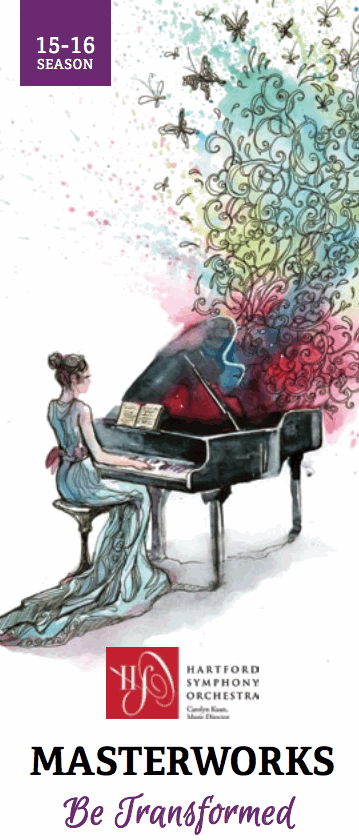
Pittsburgh ArtHartford Art

Two orchestras in the news for declining ticket sales and both chose images of women playing instruments with blobs of paint coming out of them. What are the odds? Clearly, these marketers have tapped into some universal longings that transcend geography. People in Pittsburgh and in Hartford, it would appear, have a burning hunger for women playing instruments with artsy blobs of paint coming out of them.

I would love to have been in those focus groups when young, culturally diverse respondents began talking about their pent up longings for women playing instruments that churn out paint blobs. How fortunate these marketers must have been to have gotten such rich data that gave them such clear direction.

And look at those tag lines. In Hartford, the focus group participants said they had a yearning to be transformed, while in Pittsburgh, they expressed a poetic desire for art that is somehow also play.

“When I look for ways to spend leisure time and money, I respond to abstract, artful imagery that symbolizes my deep-seated desire to morph into a different plane of reality through some sort of mystical process that includes young female musicians, musical instruments, colorful bursts of paint and an eventual transformation into something light and carefree like a butterfly.”

“When my friends and I plan our social outings, we give careful consideration to the complex, semantic interrelationships of art and play and we’re just nuts for poetry so when someone uses clever double entendres that combine these two interests, we jump at the opportunity to buy what they have to sell.”

It’s fascinating to think that new audiences in these cities would have expressed yearnings that come so close to matching the artsy images and cutesy phrases that out-of-touch arts administrators like to put in their classical music brochures.

The focus group research that I’m familiar with, meanwhile, tends to reveal more concrete desires. Rather than talking about abstract metaphorical yearnings, people talk about having a good time with friends or family, seeking entertainment that’s memorable and enriching, enjoying food, drink and art, doing something special, etc. And since motivating these people is a process of leveraging their desires, effective strategic messaging usually involves reflecting these desires and demonstrating how they can be satisfied by purchasing the product. You know, like showing people having a great time enjoying one another’s company at a concert.

I’m not privy to the research that the folks in Hartford or Pittsburgh did to understand what motivates new audiences to buy classical concert tickets, but I can’t help thinking there are young, culturally diverse people in those markets who would be better motivated to participate if they saw themselves and their actual, stated personal yearnings reflected – and satisfied – in local orchestra marketing materials.

[Title translation: You ones are not going to believe this…]

 

Time To Fire People Who Say ‘Get The Word Out’

As the audience crisis worsens, arts organizations should seriously consider weeding out administrators who say ‘get the word out.’

Getting the word out is the equivalent of using a typewriter, running off mimeographs or keeping patron data on index cards. It’s a business tool that was once useful, but is now obsolete. Arts administrators who continue to say it – or god forbid do it – are doing serious harm to their organizations.

mimeograph

Back in the mid 20th century, getting the word out was something arts organizations did so people who were waiting for the word could respond. Older arts administrators remember those days fondly and many still believe that getting the word out will solve their audience problems. But it won’t. It can’t. Today there aren’t enough people waiting for the word to make getting it out useful.

If you’re an older arts administrator who says ‘get the word out’ when you’re talking about selling tickets or growing audiences, it’s probably time for you to move on. If you’re a young arts administrator who says ‘get the word out,’ you might want to find the nearest marketing MBA program and sign up for some courses.

If you don’t understand why the phrase is so dangerous, here are three things worth knowing:

It Describes a One-Way Process

The phrase literally describes a process where insiders send information to outsiders. Older arts administrators learned a 20th century promotional approach to marketing that involves informing the public about upcoming events, so they prefer to send the word out and hope it hits enough of the right people.

Arts Organization  >>>  Word  >>>  Customers

Unfortunately, the phrase fails to describe an equally important part of the process, which is engaging with the customers and learning about their needs and desires.

Customers  >>>  Desires  >>>  Arts Organization

Arts Organization  >>>  Word  >>>  Customers

Arts leaders who say ‘get the word out’ are describing only half the market process and, as a result, doing only half the marketing job.

It Describes a Passive Process

Sending out one-way messages and waiting for people to respond is lazy.

“WE’RE DOING THIS WONDERFUL THING NEXT WEEK!!!”

Thunk.

If people aren’t waiting for the word, and don’t really care about the word, and all you’re doing is spraying the word at them, you might as well take your marketing money and throw it out the window.

People who don’t care about the word need to be moved to act. They need to be convinced that buying your product will satisfy their desires. If the word doesn’t motivate people to act by promising them something they need or want, getting it out is a waste of resources.

Look at your most recent marketing content. Does it focus on your customers and promise them something they actually told you they want? Or is it all about you and how wonderful and important you think they should think you are?

It Enables Narcissism

Older arts leaders are deeply invested in the belief that marketing is there to tell the world how wonderful and important they are. Having spent so much time back in the 20th century getting the word out to people who thought they were wonderful and important, they grew accustomed to describing their products in hyper-inflated, self-flattering promotional language, which is what people who were waiting for the word wanted to hear.

Today, people who aren’t waiting for the word don’t give a shit about the flattering things you say about yourself in your marketing content. They care about themselves and how your products will satisfy their needs and desires.

If your marketing isn’t about your customers and how your products will make them happy, and all you’re doing is telling people how wonderful and important you are, you’re just kissing your own ass in public.

Out of touch arts administrators who devote the bulk of their marketing content to kissing their own asses in public – and then complain about not being able to attract new audiences – are a major part of the reason why the arts are enduring such devastating audience declines.

<> <> <>

Here’s a change that any arts organization can make immediately to improve sales: Strike the phrase ‘get the word out’ from your organization’s business lexicon and replace it with ‘motivate customers to buy.’ If you make this one small change in the language you use, your entire communications philosophy will change and your sales will improve dramatically.

Suddenly you’ll realize that all those brochures with your conductor on the cover have nothing to do with motivating customers to buy, and that the ‘word’ you’ve been working so hard to get out is mostly just self-indulgent nonsense.

But when your business language shifts from getting the word out to motivating audiences, you’ll find yourself endeavoring to develop more meaningful connections with your customers so you can better persuade them to participate.

It’s the simplest thing in the world and it doesn’t cost a cent.

And if you still have administrators who refuse to make the change, you should probably encourage them to find another calling. Or you could always give them a cubicle with a mimeograph machine, a typewriter and a set of index cards – and name them your new Director of Getting the Word Out.


# # #

If Orchestra Marketing Were A Guy On A Date

Here’s a quiz to help you determine if your marketing content is doing its job:

Imagine that your latest season brochure is a guy on a date who’s trying to get laid, and you’re the person he’s dating. Dinner is over and you have to decide if the evening’s going to continue. To help you decide, complete the following statements by selecting one of the four numbered options:

He talked mostly about…

  1. Himself
  2. Himself and how much other people liked him
  3. Things he thought I should like
  4. Me and the things he knew I would find interesting

He asked questions about…

  1. He never asked me a question
  2. How impressed I was with him
  3. Which radio stations I listened to
  4. What sorts of things made me happy

The manner in which he spoke was…

  1. Artificial and formulaic
  2. Florid, dense and pretentious
  3. Commercial-sounding and educational but upbeat
  4. Down-to-earth, natural and conversational

wine-snobHis bearing was…

  1. Imperious
  2. Aloof
  3. Eccentric
  4. Easy-going

He described himself with…

  1. Overblown self-flattery
  2. An abundance of exaggerated adjectives
  3. Thoughtful but self-indulgent prose
  4. Assured self-confidence, but with generous respect for my perspective

He dressed…

  1. Like it was 1916
  2. Like he was planning to meet more sophisticated friends afterward
  3. A bit too formally but nonetheless tastefully
  4. With style and easy grace that made me feel comfortable with him

He really wanted me to know…

  1. A long and complex list of names of people he thought were important
  2. A dizzying array of arcane historical trivia
  3. How much I was supposed to like spending time with him
  4. How interested he was in satisfying my needs and desires

He showed me a lot of pictures of…

  1. Himself
  2. Himself and his inner circle of friends and associates
  3. Things he thought I should find interesting
  4. Things I told him I liked that he also liked

For someone who appeared to be so rich, he…

  1. Complained about not being able to make ends meet
  2. Tried to get me to pay my share plus 40% of his
  3. Stiffed the waiter
  4. Took me someplace less stuffy and a lot more fun

He asked me to…

  1. Celebrate him
  2. Support him
  3. SUBSCRIBE NOW!!!
  4. Be with him all night and make sweet love

Now, add up the value of the choices you made to see how the rest of the evening is likely to play out.

If you’re a classical music marketer and you answered honestly, your score has to have been somewhere between 10 and 20 – most likely closer to ten. The chances of that brochure getting laid tonight are extremely low.

If you scored between 20 and 30, you probably need to re-check your work.

If you scored between 30 and 40, send me a pdf right now. I don’t believe it.

Classical music marketers talk exclusively about themselves and how much other in-the-know people admire them. They don’t apply market research findings to content creation. The language they speak is artificial, florid and pretentious. Their brand imagery is imperious and aloof. They describe their products with overblown self-flattery and grossly exaggerated descriptions. They publish only photos of themselves and other insiders – wearing way to many tuxedos. They try to improve potential new customers by inserting educational content in their marketing messages. And they don’t know how to clinch the deal.

The secret to selling tickets meanwhile is talking about what your research has told you will make your customers happy. It means speaking in a natural, conversational language. It means being relaxed and approachable. It means speaking honestly about your products’ merits without overselling them. It means showing pictures of the kinds of people you’re trying to attract enjoying themselves at your venue. It means nixing as many tuxes as possible. It means never using educational marketing content to try to make people worthy of being your customers. And it means consummating the relationship by closing the sale.

If your communications content is the marketing equivalent of a stuck up, condescending, know-it-all narcissist who desperately wants something from you but can’t bring himself to take an interest in your life, it’s time for a peck on the cheek and a hasty escape.

And if the evening’s still young, maybe a stop at a popular night spot with real people and some great live music.


Marketing Advice for Arts Admin Grads

With graduation right around the corner, I thought I’d once again share some advice for senior arts administration majors who are thinking about starting out in marketing. I’ve met several young people in recent years who’ve expressed interest in arts marketing and who asked me if I thought it was a good direction. Here’s what I said to them:

1. If you’re planning to become an executive leader, don’t go into marketing. Arts leaders tend to emerge from art, management and fundraising, which are, and have always been, the legs that hold up the cultural sector stool. At about 35 or 40 years old, arts marketing is a relative newcomer that the cultural sector still regards as somewhat of an alien encroachment. This isn’t a growth industry and insiders rise further faster, so don’t waste time on an outside track.

2. If you’re serious about marketing, the arts are a terrible place to learn how to do it. Arts marketing is a quirky, idiosyncratic, quasi-professional hybrid that’s informed primarily by history, habit and the egocentric opinions of well-intentioned but inexpert executive leaders. Better to get a job in the commercial sector, learn real marketing, then return to the arts if you still want to later on. The professional expertise you bring with you will be invaluable.

3. If you do decide to forego marketing on your way to the top, try not to become a well-intentioned but inexpert arts leader. Marketing is an increasingly sophisticated professional discipline that requires hands-on experience, professional development and in-depth understanding of statistics and communication theory. Contrary to what most senior arts administrators believe, becoming the boss won’t make you a marketing expert so you’ll need to learn as much as you can along the way.

4. Whatever direction you choose, make sure you master data and learn to let it tell you what to do. The era of marketing by expert opinion is over.

5. If current trends continue, centralized big money institutions that offer traditional, passive artistic experiences like classical concerts, ballet, theatre, opera and to some extent fine art will give way to smaller, more participative, community-centered organizations that encourage individual creative expression. As this happens, senior staff positions that pay decent salaries (like marketing directors or marketing VPs) will grow fewer, and well-paying jobs will be reserved primarily for chief executives and fund raisers.

6. If you’re planning to reverse audience declines by changing the way big arts institutions do business, you might want to recalibrate your expectations. Large nonprofits and their executive leaders are change-averse by design. It’s built in. Stability, consistency and risk avoidance are fundamental aspects of traditional arts management because big, expensive art can only thrive in safe, predictable environments. Ironically, these qualities also make traditional organizations vulnerable to rapidly changing market forces so many of them will fail as a result of being inflexible. If you expect to influence change in the arts, don’t waste time trying to rescue the dinosaurs. Be the change you expect.

7. If you are not naturally inclined to interact personally, warmly, humbly, generously and sincerely with ordinary arts participants you might want to select another profession. The crumbling arts infrastructure we’re so desperately trying to prop up was created by aloof cultural elites, fourth wall-loving artists and behind-the-scenes administrators who erected massive institutional barriers to genuine audience engagement. Our job coming out of this mess will be to reconnect on a personal, human, democratic level with the people we’re here to serve.

8. If you’re tempted at any point along the way to believe that it’s about you, your organization or the art you make or sell, get up out of your chair, leave your office, exit the building, go find some of those younger people you’ve been wanting to attract, and ask them what they think it’s about. If there’s overlap between what you think it’s about and what they think it’s about, that’s what it’s about.

9. If you think sales is something icky that happens in the telemarketing room or when the intern listens to the messages on the group sales line, think again. Sales is today what marketing was back in the 1970s – the future of audience development.

10. If deep in your heart of hearts marketing is what you want to do, by all means do it. Be really good at it and don’t let some jaded old-timer tell you it’s not worth doing. The arts need good marketers who are as passionate about marketing as they are about art. And the arts need leaders who, because they rose out of marketing, know how to make policy decisions that influence audience growth and earned revenue.

So if you’re graduating this spring, congratulations and welcome. There’s never been a more interesting or important time to get involved with growing arts audiences because the sales, marketing and engagement work we do today will determine, to a large extent, whether there will be arts jobs we can all do tomorrow.

[This post was originally published in 2013. Sadly, it’s as true today as it was then.]

Donald Trump: A Model for Arts Marketers

Arts marketers who can’t sell enough tickets should pay attention to Donald Trump. He’s a surprisingly effective persuader.

Trump talks simply about things his people care about. He knows that persuasion requires clear, direct communication and he does this extremely well, using plain, down-to-earth language. And even though he talks about how wonderful he is, he somehow avoids talking down to people.

imgresHe also knows that persuasion is about emotions so he focuses on what people feel and tells them how he’ll solve their problems. His followers may feel strongly about some truly frightening things, but that’s beside the point. What’s important is not the content of the language, but rather the techniques he uses to get the results he wants.

Barack Obama used the same techniques.

Speaking simply about things people care about is a good way to get votes, and it’s a good way to sell tickets.

Take a look at your latest promotional piece. Did you speak simply about things your new audiences care about? Did you appeal to their emotions? Did you describe how your products would solve their problems? Did you describe your best attributes without being condescending?

If you’re a traditional arts organization, the answer is most likely no.

If you’re like most arts marketers, you talked in a fancy, superior, self-centered, self-flattering and possibly even academic language about how wonderful you are without having bothered to address what new customers care about. They’re probably trying to figure out how to enjoy an evening out with friends while you’re telling them how important Ibsen or Shostakovich or Balanchine is.

In the arts, we don’t focus on what our new customers want; we focus on what we think they should want, and this is why we’re failing so miserably at attracting new audiences.

Speaking in fancy language about things we wish other people cared about as much as we do is an absolutely terrible way to sell tickets, yet it remains the primary strategic approach used by traditional arts organizations.

Will Donald Trump prevail? Probably not. He appeals more to what people fear than he does to what they hope for. He’ll probably lose to a candidate who appeals to more aspirational yearnings.

Ironically, in the arts, where aspiration is the name of the game, we don’t bother to learn what new audiences want, so we can’t tell them how our products will satisfy their desires.

In arts and in politics, the winners will be those who do the best job of learning what their audiences aspire to, and then describing how what they’re selling will make people happy.

Why would new audiences vote for you?


A Miracle at San Diego Opera

I’ve been a bit tough on San Diego Opera in the past. Especially here, here and here.

But the other day I got a brochure that contained a miracle. San Diego Opera actually published photos of audience members enjoying one another’s company at the show!

SD PEEPS 1I was shocked. It is astonishingly rare to find arts organizations depicting customers having a good time with one another at the venue. Research consistently demonstrates that people choose arts events for social reasons, but arts organizations remain stubbornly resistant to the idea of focusing on their customers’ motivating impulses. Arts organizations use marketing materials to promote what they think their customers should want, not what the customers actually do want, so it was a thrill to see San Diego Opera giving priority to their customers’ social experiences for a change.
Arts leaders want to see themselves reflected in their marketing materials, not their customers, so I know this was probably a tough sell. But I think San Diego Opera deserves to be recognized for stepping outside the self-centered, tradition-bound, nonprofit bubble and doing some customer-centered marketing for a change.

If customer-centered marketing is common practice in professional marketing, it should be common practice in the arts as well.

Great work, SDO. I hope it’s the beginning of a very productive new direction.


The Impotence of Being Important

Arts leaders who believe that art is important spend a lot of time telling the world how important their art is. These executive decision makers tend to believe that telling people how important something is is a useful way to get them to participate.

Tragically, it is not.

Your importance, dear arts leader, is a motivating factor only to those who possess a desire to participate in what you think is important. Traditional audiences may share your belief in the importance of your art form, and may thus be compelled to participate, but future audiences, the ones you need for survival, are an entirely different animal.

New audiences are well aware that your organization could disappear overnight and their lives would remain unchanged. You may have strong convictions about the value of your organization, but your belief, and the self-important communication it engenders, doesn’t influence behavior.

New audiences are motivated by what’s important to them.

If you want to influence behavior, you have to find places where what you think is important and what new audiences think is important overlap. For example, if you’re a performing arts organization and your research reveals that younger audiences are looking for ways to enjoy social experiences that include quality entertainment, the most important thing you can do is market social experiences that include quality entertainment – and that means making the content of your marketing about their social experiences.

Sounds simple, but wait ’til you see the look on your artistic director’s face when half the photos in next season’s brochure are of young, culturally diverse people enjoying one another’s company in the lobby bar. If the arts suddenly decided to make marketing content about the customers (a practice that professional marketers take for granted) heads would explode throughout the industry.

Arts leaders want to see what they think is important in the brochure: art, artists, themselves, venues, donors, Asian children at education events, etc. Customers simply don’t rank high enough to make the cut. (No, those photos of audiences clapping at your stage don’t count.)

Customers want to see themselves in your marketing materials – especially new customers who don’t yet understand, and can’t quite envision, how your products will make them happy.

If new audiences can’t see themselves in your marketing materials, they’ll know just how important they are to you – and that will help them decide how important you are to them.


Who’s Your Senior-most Outside Sales Executive?

Doug Borwick has a great post over at Engaging Matters where he makes an interesting connection between engagement and sales. Check it out.

I know the question in my title will be confusing for most arts professionals. Outside sales executives are virtually non-existent in our industry. In most cases, the answer – if there is one – will look something like this:

  • Our senior-most outside sales person is our telemarketing manager
  • Our senior-most outside sales person is our subcontracted telemarketing agent
  • Our senior-most outside sales person is our group sales manager
  • Our marketing director just had the word ‘sales’ added to her title
  • Our marketing VP is in charge of sales

Outside sales is a process of connecting personally with people in the community. It’s about identifying community members who have an interest – or potential interest – in our products and developing relationships that will facilitate their access. The essential ingredients of outside sales are:

  • Spending plenty of time out in the community
  • Making personal connections with potential buyers and partners
  • Building productive, long-lasting relationships
  • Ensuring that those relationships result in mutually beneficial business transactions

Telemarketing obviously doesn’t fit the description, nor does group sales, which, while it’s often meant to be outside sales, is usually a bottom-rung customer service function.

Some organizations assign sales duties to senior staff members, but those duties are almost always about managing the organization’s passive sales, which means satisfying available demand with appropriate systems and services. Making sure the organization can service existing demand is important, but it is definitely not outside sales and the staffers who oversee the processes spend little to no time in the marketplace initiating new sales relationships, much less connecting buyers to the organizations’ products.

Sales for most arts organizations means spraying impersonal marketing messages at the community in hopes of “getting the word out” to people who care about the product, and then ‘selling’ them tickets when they respond. Our entire organizational/industrial culture is built around this model, which is why outside sales is such a foreign concept.

I don’t know about you, but I find it ironic, and maybe just a little bit tragic, that an industry that complains so bitterly about its inability to sell tickets doesn’t actually sell tickets.


Philadelphia Orchestra Fails the Gal-in-a Starbucks Test

We read last week that the venerable Philadelphia Orchestra is losing audiences.

Attendance in 2014/15 was down by 7,000 paid listeners from the previous season and off goal by 36,000. When board chair Richard B. Worley announced the bad news he said, “I don’t know if it’s because the audience isn’t here, or the audience is here and we don’t know how to reach them.”

As regular readers of this blog know, when I read about arts organizations that don’t know how to reach audiences – or don’t know if their audiences even exist – I visit their marketing materials to look for signs of trouble.

Take a look at this brochure and count how many photos there are of young, culturally diverse people enjoying one another’s company at a concert. Then count how many photos there are of Yannick Nézet-Séguin.

Uh-huh.

Or you can judge how well the orchestra does on the “Gal-in-a-Starbucks” test:

Imagine yourself sitting in a busy Starbucks where the woman sitting next to you is a smart, 28-year-old tech executive who, as it turns out, played viola in her college orchestra. You get to chatting and you decide to persuade her to come to your concerts, so you lean in and say:

“A very good friend of The Philadelphia Orchestra, the much-sought after Italian conductor Gianandrea Noseda returns to lead two programs of musical travelogues. This first program kicks off the wintry season traversing the icy landscapes of Finland, Poland, and Russia. Tchaikovsky’s First Symphony (“Winter Daydreams”) paints a vivid picture of the snowy Russian countryside. “There is a particular quality of the sound of this orchestra, which is connected with the old Russian way of making sound,” says Noseda, and it will be on full display with this shimmering delight by Tchaikovsky. The “spectacular” Leonidas Kavakos, “a marvel of exactitude” (The Philadelphia Inquirer), returns with the exquisite and demanding Sibelius Violin Concerto. Kavakos, who was still in his teens when he came to international attention winning the Sibelius Competition in 1985 performs Sibelius’s depiction of chilling Scandinavian fjords. Lord Byron and Victor Hugo both told the tale of Ivan Mazeppa, a Slav who seduced the wrong Polish princess and was tied to a wild horse as punishment. Liszt’s fast-paced symphonic poem sets the folk story to lively music in our opening work, which, like the stallion in Byron’s poem, is “loosed … with a sudden lash.””

Yikes. Travelogues? Icy landscapes of Finland and Poland? Snowy Russian countryside? The old Russian way of making sound? A marvel of exactitude? Chilling Scandinavian fjords? Lord Byron and Victor Hugo?

What hot-blooded young music lover wouldn’t rush to buy tickets to all that?

Chances are the 36,000 people who stayed away last season have a lot in common with this horrified young coffee drinker. They’re looking for stimulating social experiences with rich emotional content while the Philadelphia Orchestra is selling convoluted history lessons with frigid geography, Italian exactitude and obscure Byronic horses.

Is it fair to suggest that this dorky chunk of pompous blather is the cause of the orchestra’s audience problems? Maybe not. But if the language is representative of the self-centered, self-important and self-flattering – not to mention condescending and insufferably didactic – communications content that marketers in Philadelphia (and elsewhere) use to sell classical music to the world outside the bubble, it’s worth pointing out.

The article says that Michael Kaiser has been brought in to help. Perhaps he should start by asking the communications department to spend a month or two at their local Starbucks learning how to talk to real Philadelphians.

Here’s a tip for classical music administrators who still think that narcissistic bombast is good marketing strategy: The language you’d use to persuade a young woman in a coffee shop to enjoy a night out with friends at a concert is the language that belongs in the brochure.

Is Churn Driving You Crazy?

Been a bit busy with projects in Palm Springs, but thought this re-post would also add to the conversation Doug Borwick and TRG Arts are having about the relationship between engagement and marketing.

FREUD UND CHURN

I was chatting about audience development recently with a fellow who manages a prominent performing arts institution and the discussion turned quickly toward the subject of churn. He was having problems with uncommitted single ticket buyers who returned infrequently or never at all and it was driving him crazy.

The more he talked about his churn problem, the more disdainfully he spoke about his unreliable, marginal, inconstant customers and the more obvious it became that he resented them deeply for the damage they were doing.

Later in the same conversation we talked about new audiences and he began to speak eloquently and surprisingly optimistically about untapped markets of loyal ticket buyers that he was certain lay just beyond his grasp. He was convinced that there were new audiences out there that weren’t being properly courted and that, if they could be found, would be the answer to his audience development problems. I could tell by the way he spoke that he was tremendously fond of these people, imaginary though they were.

What fascinates me about this, and other conversations I’ve had just like it, is the disparity in affection we maintain for the audiences we have and the audiences we wish we had. I admire the optimism that allows some to envision an enthusiastic, loyal, well-behaved audience that has yet to be properly persuaded, but I worry that belief in such an ideal may be preventing us from facing an unwelcome truth, which is that the new audiences we’re looking for are going to be found among, or near, our least favorite customers.

You know those folks who bought half-price tickets through that online discounter? Or the people who got vouchers through their HR office? Or the kids who used Grandma’s subscription seats that one time when she was in Florida? Or the couple who came with that other couple who bought some extra singles at the last minute? Or the folks who were at the hotel down the street and popped in for lack of anything better to do? Or the business guy who came because his client was an arts fan? Or that gaggle of young people who decided to try something different but left at intermission? Or the out-of-place-looking young couple in the cheap gown and hand-me-down jacket? Or the folks who came once because a starchitect designed the new venue? Or the people who were more interested in drinks and dinner than they were in the show? Or the people who came to the one event that featured people like them but then never came back? Or the folks who came on the bus with the person who placed the order with the intern who returns the messages on the group sales line? You know; those people?

Uh-huh.

We can dream all we want about external, ideal, as-yet-undiscovered audiences that are comprised of younger, more culturally diverse people who behave just like the audiences we have now, but those audiences are a delusion. The audiences that do exist are the ones that are coming now – and others very much like them who are not as well motivated but who are nonetheless more likely than the rest of the world to give us a try. These are our marginal and adjacent audiences – our new audiences – and they’re our future.

A few months after our conversation, my churn-weary friend’s organization sent me a subscription brochure that was every bit as old-fashioned, cliché-ridden and insider-oriented as the stuff that arts organizations started sending out when Danny Newman wrote Subscribe Now! thirty five years ago. He wanted the churn to stop, but he couldn’t bring himself to face, let alone speak to, the dreaded churners on whom his survival depended.

“Displacement” is a word that Freudian psychologists use to describe what happens when people substitute an imaginary ideal for an unacceptable reality. It’s a defense mechanism that helps otherwise healthy people cope with difficult situations. Unfortunately for some, displacement can become a debilitating disorder that prevents them from recognizing and dealing with the world as it is.

Crazy, huh?