What the Tea Party Can Teach Arts Professionals

I learned on NPR’s Morning Edition this week that the speaking style of congressional representatives has changed in recent years.

“It turns out that the sophistication of congressional speech-making is on the decline, according to the open government group the Sunlight Foundation. Since 2005, the average grade level at which members of Congress speak has fallen by almost a full grade.” – npr.org

Using an algorithm that measures readability in terms of grade level, researchers analyzed the Congressional Record to track this junior- to sophomore-level decline, which appears to have been fueled by the influx of Tea Party freshmen.

At first I thought the story was about the dumbing down of the US Congress as a result of an invasion of less intelligent, less well educated, socially conservative firebrands, but that’s not how it turned out. Much to my surprise it was a story about some unusually adept communicators who’ve learned that political discourse – even on the house floor – is a highly public, highly persuasive affair.

Instead of being embarrassed by their achievement, several of the lowest-scoring members boasted about having found a more effective way to appeal to their constituencies. Rather than embracing a long-standing tradition of statesmanlike eloquence, some new members have opted to speak a more common vernacular in the nation’s capitol knowing that cameras and microphones will deliver their straightforward message to voters back home.

Like arts marketing, political speechmaking in Washington was once an elevated, peer-to-peer endeavor that involved using a sophisticated, somewhat exclusive insider language. But the tea party has learned that motivating new voters means speaking to them in a language that’s unencumbered by formal tradition, frivolous ornamentation or academic complexity.

South Carolina Republican Mick Mulvaney, who scored lowest on the scale, Graduated from Georgetown University with honors then earned his law degree at University of North Carolina Chapel Hill. He said his father, who was a grammar teacher, trained him “to write in a clear and concise fashion. You didn’t use big words if small words would do.”

I’m no fan of the Tea Party or their language guru Frank Luntz, who teaches them how to persuade voters, but I do know that Luntz is right about this: “Life has changed. Voters not only expect, but they demand that members of congress communicate in a way that is more understandable and more meaningful to them.”

The lesson for arts professionals requires only a small adjustment in Luntz’s words: Life has changed. New audiences not only expect, but they demand that arts organizations communicate in a way that is more understandable and more meaningful to them.

If your organization is still using the flowery, self-congratulatory, hyperbolic language of 20th century arts marketing, it may be time to take a cue from some very effective (however potentially objectionable) politicians and start speaking in a more direct, more persuasive language – one that your undecided audiences understand.

The Language of the Arts is Passive (plus cute puppies!)

Sometimes paying attention to the language we use while talking about the language we use can be revealing. For example, consider how often phrases like “spread the word” or “get the word out” pop up in your marketing discussions.

“We think placing this ad in the Weekly will really help us get the word out.”

The idea of spreading the word dates back to a time when there were so many people who cared about what we did that getting the word in front of them was enough to elicit a sufficient enthusiastic response. Given the way the marketplace has changed, though, I’m astonished when arts professionals still say “we need to spread the word” or “we have to generate awareness” or, God forbid, “we need to publicize this event” as if spraying information at the market is still a sufficiently strategic approach.

In my home we have two dogs. One of them loves to go for a walk but the other is usually pretty content wherever he is, which is often in bed. They both enjoy the actual walking, but their initial inclinations couldn’t be more different. If we shake the leashes and say, “Who wants to go for a walk?” Dewey comes running but Hoover doesn’t budge. So, in our house, getting the word out only works on the dog that’s sitting there waiting for the word.

The problem with getting the word out is that it’s passive. It is entirely dependent on there being a sufficient quantity of people — or beings, if you will — in the market that are eager to hear the word. And if there aren’t enough sufficiently motivated people waiting for the word to meet our sales goals, then getting the word out doesn’t work.

In our house, when the word is “walk,” only fifty percent of the available market is interested enough to respond. If we had two Hoovers, we could stand at the door shouting, “go for a walk” all day long and the business simply wouldn’t get done.

Of course we can try to make the word more enticing:

Who wants to go for a walk? It’s a beautiful day… I’ve got poop bags…. Whistle. Whistle.

The Springfield Arts Center proudly presents Cirque du Fromage, the high-flying aerial circus The New York Times calls “a dizzying, death-defying delight.” There’s something for everyone in this action-packed acrobatic extravaganza.

 And we can issue urgent calls to action:

 Better come now or we’re leaving without you!

 Don’t miss this rare chance to experience the thrills and excitement…

But if the fundamental impulse isn’t there, the desired behavior simply won’t follow.

Fortunately, Hoover’s motivations are fairly transparent; all we have to do is open the cupboard where the dog supplies are stored and say “treats” and he comes running. For us, motivating our non-avid audience is a matter of making a premeditated, strategic, audience-oriented message choice that triggers the behavior we want from our less well-motivated target.

For the arts, where pre-existing interest is waning, getting the business done will mean choosing strategic messages that work on customers who need more compelling motivators – something like, maybe, cute puppies?

[This post is adapted from my book “Marketing the Arts to Death: How Lazy Language is Killing Culture” – Available at Amazon and other e-book retailers]

Five No-cost Things Arts Orgs Can Do Right Now to Increase Earned Revenue

Arts organizations can generate significant increases in paid participation by simply changing the way we talk to new audiences. Here are a few steps you can take right this minute at no cost to start the process.

Stop Bragging. Talking endlessly about how wonderful you are is about as interesting as the guy you meet at a party who blathers on about his superior exploits and never asks about you. Put yourself in the position of a fence-sitter who has to hear that pompous litany coming out of your marketing department and ask yourself honestly whether you’d rather have someone describe what’s in it for you instead. Tip: When you develop promotional messages, focus less on yourself and more on the audience and the good time they’ll have enjoying your events.

Talk to Somebody. Most arts marketing is self-centered bravado that insiders dream up in conference rooms to tell the world what they’re up to. But guess what? The world doesn’t care. The reality is that there’s a predictable population of people in your market who do care, and a few more who might care if you talked to rather than at them. Tip: Develop promotional materials that speak directly, honestly and persuasively – in a natural language – to the individual human beings you’d like to see at your next event.

Know Your Audience. A couple of years ago over at Artsjournal.com a senior arts administrator wrote about having been invited to an orchestral concert where she was forced to sit in the balcony – clearly not her natural habitat – and wound up chatting with a humble subscriber named Bob. The epiphany she described having had during her exile was that people like Bob actually matter to arts organizations. The epiphany I had reading her story was that senior arts administrators need to spend a hell of a lot more time in the balconyTip: (I’m not even going to say it. If it’s not obvious, there’s no hope.)

Make your Case. The only way to persuade people to buy is to let them know how your product satisfies their desires. Back in the 20th century, there were a lot of people who had a deep-seated, self-motivating hunger for the arts so all we had to do was say “we’re here” and they came. But today those people are dying and their heirs don’t have the same built-in motivators so we have to make the case more explicitly: “We’re here and this is why you should come.” Tip: Get in the habit of spelling out for potential audiences, in every single promotional message, why you’re worth their time and money.

Be Humble. Young people can live their entire lives without ever setting foot in our venues and get along just fine. It doesn’t mean they’ll be deprived of art; it just means they’ll choose forms of creative expression that they find more appealing. If we want new audiences, we’ll have to accept the fact that we need them more than they need us, and then compete as equals in a broader, more democratic, non-hierarchical, user-controlled creative marketplace. Tip: Stop producing promotional messages that talk down to the world and start listening to the conversation to learn how best to participate.

I’m aware that most arts leaders didn’t go into the arts to sell increasingly unpopular products, fraternize with little people like Bob, compete with Youtube videos or swallow their egos once they’ve reached the top, but if they’re the ones who decide how to speak to a changing world, they’re going to have to learn a new language.

And as for young arts marketers, it’s up to you to teach that language to your tradition-bound bosses and insist that they let you speak it. They may be retiring before the audience disappears so they may not care enough to change. But if you want a life-long career in the arts – and maybe want to have have your boss’s job some day – you can’t afford to wait.

If it’s Pretty and it Doesn’t Sell, It’s just Pretty

I did some work not long ago for an arts organization that wanted to generate a 25% increase in participation from a specific target audience. It was a fairly straightforward gig that involved profiling an audience that the organization hadn’t paid much attention to, and reaching out to them in a more focused, more persuasive manner.

We started by learning as much as we could about who these people were and why they came. We spent many hours in the venue speaking with patrons about their motives and habits, and many more hours researching the organization’s databases to segregate them and make sure we could speak to them independently. Then we reached out to key experts in the marketplace to solicit their advice and learn how best to communicate with this particular audience.

Once we’d gathered the necessary information, we laid out a message strategy to guide us in developing marketing materials. The strategy contained recommendations for using language and imagery that would motivate this target based on what we’d learned about them. Eventually, I forwarded the strategic recommendations to the organization’s graphic designer and that, to my chagrin, was where the whole process went to hell.

The designer came back with a mock-up that had nothing to do with the strategy. It veered dramatically away from both the language and the imagery guidelines; it obscured the selling points into relative meaninglessness; it reverted to flat clichés; and it replaced strategic, persuasive, audience-oriented content with bland information that was all about the product.

Consultants ride a fine line between doing what they’ve been hired to do and making their clients happy – which are not necessarily the same things – so I said, gently, “I’m wondering why we’d want to disseminate a message that differs so significantly from the strategy we agreed on,” and the answer that came back was this:

“Margaret has been designing our materials for fifteen years. She knows our style and she’s responsible for managing our brand. The stuff you suggested didn’t fit into the template we use for these sorts of things so we had to cut most of it. And the images you recommended didn’t reflect our seriousness of purpose. Plus, we looked at what other arts organizations were doing to target this audience and it validated our thinking.”

(If you’ve ever wondered why traditional arts organizations are tanking, you can find five of the most compelling reasons right there in that paragraph.)

I have enormous respect for graphic designers, but their job is not to develop the message strategy. The senior marketing staffer is responsible for the strategy and the designer’s job is to execute that strategy in the most effective manner. Message development starts with the audience, moves through the marketing team, which interprets market intelligence and applies rational methods to shaping appropriate responses, then moves to the designer, who’s job is to apply his or her expertise in visual communications to make the strategy work. At the end of the day, marketing is all about sales – not tradition, not consistency, not pretty pictures, not staff seniority and definitely not propping up a respected but inert brand. As legendary advertising guru David Ogilvy famously said, “If it doesn’t sell, it isn’t creative.”

Unfortunately, I’ve worked with enough arts organizations to know that graphic designers tend to have more influence on message strategy than prudence would dictate. In some cases they’re the ultimate arbiters, as in the example above, and in others they’re the default determiners of message strategy because the marketers and executive leaders don’t know how to direct them. But that’s not what designers are there to do; it’s not what they’re trained for. Asking designers to bear the responsibility for marketing strategy is like asking the set designer to direct the play, the acoustical engineer to conduct the orchestra or the exhibit designer to curate the show.

The sad thing about the organization above was that the materials didn’t generate a 25% increase in results because the designer wasn’t prepared to accommodate a 25% change in the way she developed marketing messages.

How about you? Is the person who designs your message strategy the same person who designs your messages? How’s that working for you?

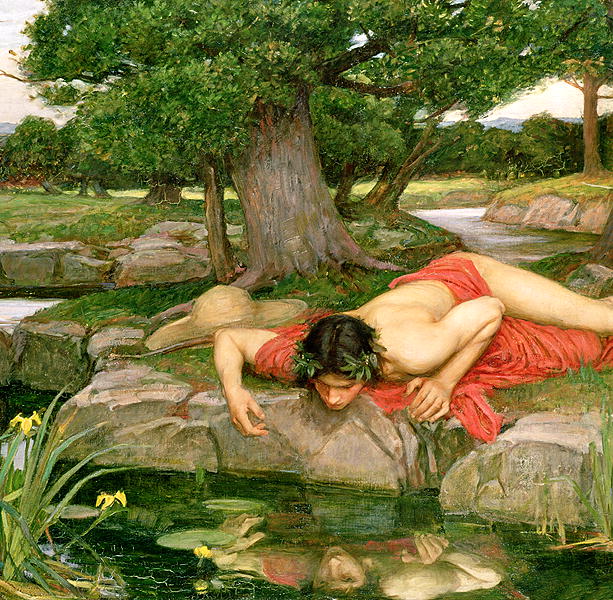
Narcissus and the Executive Director: A Story about Love

Once upon a time a young maiden fell madly in love with a beautiful youth, but when she declared her love for him he rejected her callously as was his habit. So the maiden cursed the haughty youth and prayed that he, too, would come to know unrequited love.

One day the youth stopped in the woods to drink from a pool of water. When he bent toward the still pool he saw his reflection and fell madly in love with it. But when he reached out to embrace his new love, he found that he was unable to possess the object of his passions. So transfixed was he by this beautiful but elusive reflection that he sat and stared at it for days on end, foregoing all movement or nourishment, allowing his body to weaken and his beauty to fade.

Soon the maiden found the youth and took pity on him, even though his looks no longer elicited her passion, but she was unable to break the curse.

Eventually the youth died and the despairing maiden wandered off into the countryside never to be seen again.

It’s Echo and Narcissus, of course, a tale about the dangers of being so self-consumed that you lose your connection to those who sustain you. I’m repeating it here because it illustrates a curious dynamic that exerts a powerful – and perhaps even tragic – influence on the the way we in the arts communicate with the world around us.

In the cultural sector, the captivating reflection in the pool is comprised of all the places we look for validations of our worth: rave reviews, feature articles, press releases, quote ads, social media, glossy brochures, street pole banners, adoring fans, loyal audiences, elbow-rubbing celebrities, big donors, envious colleagues, bitter competitors, fawning socialites, prying media, cheering crowds, ambitious employees, flattering wannabes, needy artists, and sometimes even the actual integrity of the artistic products we place in our venues. People who work in the arts, especially those who’ve made it to the top, don’t have to look far for flattering reflections, and most find them irresistible.

There’s nothing wrong with seeking affirmation in the world around us, of course, but arts leaders have the unique ability to manipulate some of those reflections, and that’s where the danger lies. To illustrate how the dynamic works, consider a typical marketing meeting where the executive director is about to weigh in on some new campaign ideas. The marketing team has been hard at work developing concepts and they’ve come up with three to present.

The first idea is a traditional approach with pumped up, self-congratulatory language, star photos and flattering media quotes. The second idea overlays a clever thematic through-line onto the season lineup and uses a witty bit of wordplay as its principal attention-getter. The third idea is less flashy, but it’s based on research showing that less-avid consumers lack the ability to envision themselves enjoying time in the venue. It focuses on the audiences and the good time they’ll have coming to the events.

Which idea will generate more revenue? The third one. It’s based on research and it focuses on the customers. There’s no substitute for doing homework and structuring appeals that demonstrate how your product will satisfy what the market wants.

Which one will the executive director pick? The first one, of course. The one that tells the world how wonderful his organization is. There’s not an arts leader in the industry that doesn’t want to open the Sunday paper and see something printed there that makes him look successful — even if he designed it and placed it there himself. In that exquisite moment when a senior decision maker has to choose what his (or her) reflection will look like — in the Sunday paper or any other medium — every instinct, every emotion, every experience he’s had in the industry will compel him to go with the option that casts him in the most favorable light.

Arts executives, because they are almost universally amateur marketers, cannot separate their ego investments in their organizations from the cool, rational decision-making skills that are necessary for effective marketing. Trying to convince them to opt for the strategic audience-centered route is tantamount to Echo tapping on Narcissus’ shoulder saying: Rise up, dear youth, from yonder bank; pray look in my direction. Tis death for him whose eyes stray not from love’s inverse reflection.

Narcissus’ only hope for survival was to resist the temptation to dwell on his reflected wonderfulness and recognize that he was dependent on the simple, unremarkable people in the village whom he held in such disdain.

If being wonderful and constantly reminding the world how wonderful we are isn’t enough to sustain the arts, maybe we need to focus a little bit more on the people who will be taking care of us when our wonderfulness is no longer evident.

[This post is adapted from my book “Marketing the Arts to Death: How Lazy Language is Killing Culture.”]

It’s Time for Arts Execs to Zip It

It’s a time-honored custom in the arts to allow executive leaders to vet campaign ideas and select the content of the communications that will be used to market their organizations. Unfortunately, these leaders often have no academic background in communications and no meaningful experience with professional marketing practices, so their choices tend to be more about tradition, gut instinct, ego and personal opinion than they are about objective, external considerations.

The problem with this, of course, is that objective, external considerations are the only worthwhile considerations. The expert opinions of under-educated, inexperienced arts executives are of extremely limited value and the process of letting the highest-paid person set marketing strategy – whether or not that person arrived in the position with sufficient expertise – is outdated, amateurish and increasingly counterproductive.

This will be painful news for arts leaders who believe that rendering opinions on marketing is an important part of their jobs, but the arts can’t afford to let that happen anymore. With arts organizations closing their doors from coast to coast, it’s time for senior arts execs to stifle their subjective marketing impulses, keep their opinions to themselves and start letting objective market data tell them what to do.

The only way to understand the potential effectiveness of a communications strategy is to determine if it promises to satisfy the needs, wants and desires of its target audience. And the only way to do that is to know exactly what the target audience needs, wants or desires. If you’re an executive leader, your job when vetting marketing materials is not to insert your personal opinion into the process, it’s to make sure your marketing staff can answer these questions:

  • Who are we targeting?
  • What have our target audiences told us they want?
  • How do we know that? Have we guessed or have we gathered reliable information?
  • Have we established motivating connections between what the target has told us they want and what’s true about our products?
  • Is this the most effective way to convince target audiences that our products will satisfy their yearnings?
  • Does this message strategy appeal to old audiences and new audiences alike? How?
  • Does this message strategy compete effectively for their attention and interest? Are the attention getters and enhancements consistent with the strategy?

As for considerations that the arts normally use to evaluate materials – How did we do it last time? What do other arts organizations do? Will the artistic director freak if we don’t use his photo? What will my industry peers think? Wouldn’t it be easier to do what we’ve always done? How will the board chair react? Shouldn’t the Arts Council credit be larger? I like the one that tells the world how wonderful I am we are. Shouldn’t we be mentioning the education program? Will the foundations be pissed if we do something they don’t understand? Can’t we slip in a funding pitch on the last page? I just know it would be prettier in blue. Will people think we’re tacky if it looks too salesy? Why’s the logo so small? Isn’t the logo the brand? I thought the logo was the brand. What if they find out I don’t really know that much about marketing? – You can use them if you want, but arts leaders who are genuinely concerned about the fiscal health of their organizations would be well advised to set aside self-centered concerns and begin approaching marketing strategy from the perspective of the people who matter most.

Effective marketing starts with the audience – not with a group of insiders sitting in a conference room filtering spontaneous creative inspiration through a gauze of tradition, subjectivity and dubious expertise. The senior executive’s role in this process is to keep the focus on the customer and make certain that strategic communications are developed in response to reliable, external market intelligence. I’m well aware that this is a radical departure from accepted practice and that professional, audience-centric marketing is not part of our culture, but audiences have been disappearing for several decades now and there’s no excuse for perpetuating amateur methods that fail to prevent – or perhaps even hasten – their departure.

If you’re an arts administrator who’d like to give professional marketing strategies a try, the simplest and perhaps best first step is to do this: No matter who you are, how high you are in the food chain or how much you think you know, when it comes to marketing, if you’re inclined to start a sentence with “I think…, say “We know…” instead.

If you can’t finish the sentence because you don’t know, find out.

Had a Fascinating Chat with my Mailing List the Other Day…

I once worked for a performing arts organization that sent out a steady stream of repetitive, self-centered, shamelessly boastful marketing messages that, for all their bravado, were about as interesting as old wallpaper. One day in a marking meeting I said, “I wonder if it might be useful to step back and think about the audiences we’re targeting to see if what we’re saying resonates with them. I mean, who are we talking to?” And the marketing director said with withering condescension, “Trevor, dear, we’re talking to everyone.”

I hope it goes without saying that talking to everyone is the same as talking to no one, but I’ll say it anyway: Talking to everyone is the same as talking to no one. The essence of marketing is appealing to the needs, wants and desires of a particular audience, so if you’re talking to everyone, you either have to appeal to every need, want and desire in all of humanity or you have to put your information out there and hope that it hits enough people who’s needs, wants and desires fit with what you’re selling. The latter, of course, pretty much sums up what arts marketing has been about for the last half century.

If you can’t describe exactly who you’re talking to when you craft your marketing messages, you can be absolutely certain that those messages are NOT strategically persuasive. They may be informative and they may even be enticing, but persuasion means knowing what your audience wants and then demonstrating how your product will satisfy their yearnings. If you can’t describe who you’re talking to, you can’t possibly know what they want. And if you don’t know what they want, you can’t describe how your product will make them happy, which is what satisfying yearnings is all about.

“Oh, but Trevor, we know who we’re talking to. We’re talking to arts lovers and we’re telling them about things they’ll really be interested in.”

Yeah, well, that’s really quite charming but this is 2012 and the likelihood of there being enough self-motivated arts lovers within your sphere of influence is getting slimmer every day. Arts marketing messages can’t just appeal to the pre-motivated. They have to motivate, which means they have to be strategically persuasive, which means they have to promise to satisfy the needs, wants and desires of the people you’re talking to – especially if you’re hoping to attract new audiences. If you’re talking to some abstract population of generic arts lovers and there aren’t enough of them in the marketplace to meet your sales goals, you’re not going to sell enough to stay in business. Period.

So here’s a tip for replacing those generic target audiences with actual people so you can start motivating more of the behavior you want. Divide your current audience into archetypes. Group them into categories like, perhaps, empty nesters, the founding generation, busy moms, gay professionals, etc. (Don’t just make it up, examine your data and your actual audiences carefully.) Then, do the same thing for new audiences. Decide who you want to see in those empty seats or galleries and craft archetypes for them as well.

Next, describe those archetypes in terms of their demographic characteristics, levels of interest in your product and lifestyle choices. Using the market intelligence you’ve gathered, craft profiles that describe your submarkets in detail, taking care to include information on what they want and how your product can satisfy their yearnings. Be honest, be as objective as you can and never make assumptions that aren’t supported by data.

Phil and Honey

Then – and this is the really important part – create and name characters that personify your archetypal profiles. Give them lives and personalities and make them as real and vivid as you possibly can. Find or take photos that bring those characters to life, blow them up and place them on your conference room walls. Work with your administrative colleagues to create a family of audience prototypes, make them part of your daily administrative conversations and get used to referencing them, by name, whenever you discuss marketing strategies.

Here’s a promise: If those photos and profiles are on the walls in your conference room the next time you sit down to develop marketing messages, your messages will be far, far more effective. Knowing exactly who you’re talking to will force you to speak to them rather than at them, it will force you to address their needs, wants and desires, and it will help you steer clear of the lopsided, narcissistic self-flattery that so often passes for strategic messaging in the arts.

Next time, try talking to individuals rather than to your database and I guarantee you’ll have a much more interesting conversation.

Engagement and Sales: Same Thing?

The more I hear about engagement, the more it sounds like a well executed sales strategy. And the more I think about sales, the more inclined I am to believe that folks who advocate on behalf of engagement – at least in the realm of audience development – could benefit from a deeper understanding of how sales functions in more businesslike contexts.

This may seem counterintuitive – especially in the arts where the icky business of sales is relegated to low-level boiler room functions like telemarketing and group sales – but in the commercial sector where sales is a natural counterpart to marketing, it’s a perfectly sensible perspective.

Back in the 90s I worked for Cameron Mackintosh as a sales executive. My job was to sell The Phantom of the Opera, Les Misérables, Miss Saigon and other Broadway shows to business-to-business (B-to-B) buyers, most of which were part of the travel & tourism industry. Sales was an accepted practice in London’s West End back then but it was new to Broadway and introducing it there was a fascinating process of creating connections between two industries that had mutual interests but hadn’t been properly introduced.

Here’s what we did: We watched, listened and learned. We sought external expertise from local agencies like New York’s Convention & Visitors bureau and other sales professionals in our market who’d been working with the travel industry longer than we had. We joined trade associations for tour operators, meeting planners, travel agents and other related professions and we traveled around the world attending conventions and conferences where these businesspeople conducted their business. Eventually, we began taking Broadway and London actors with us and mounting performances in the convention centers and hotel ballrooms where these gatherings took place (a practice that’s now common in Broadway sales & marketing).

But it went even beyond that. We stepped way outside of the comfortable confines of our small, insular industry and endeavored to learn how our new partner industries worked so we could better describe how our products and services met their needs. We developed personal relationships with our clients and their colleagues so we could better understand who they were and what they expected from our products and services. We invited them to see our shows as guests (unheard of on Broadway at the time) and solicited their feedback to learn how we could make our products more accessible to their clientele. And we changed the way we did business, where possible, to accommodate their needs.

In short, we engaged with them proactively in their worlds so we could better facilitate their engagement with us in ours.

I realize, of course, that there are those in the arts who pursue engagement for purposes that have nothing to do with ticket sales, but I think this story contains at least two worthy takeaways for those who expect engagement to have a positive influence on audience development.

1. Engagement is a two-way street. We can’t just sit in our offices and conference rooms trying to dream up ways for audiences to engage with us. If we want to engage new audiences, we have to figure out who they are, find out where they live and then go out to engage with them on their terms and on their turf. And that doesn’t mean just tweeting or being on Facebook or sending interns out with flyers; it means real, person-to-person external engagement – and that means executive level staffers and artists out in the marketplace making meaningful human connections with the people they most want to see in their venues.

2. Engagement requires adaptation. We can’t say we want people to engage with us and then hand them a set of rules for how it works. That was how Broadway approached B-to-B buyers before we started our outbound sales process and it was why those buyers bought so few tickets. (And it’s how a lot of highbrow arts institutions still treat uninitiated audiences.) If we want to engage with new audiences, we have to let them tell us what they want and then, if it’s possible and appropriate, change the way we operate to accommodate their wishes and expectations.

Sales, in its ideal sense, is about creating relationships that transcend transactions. It’s about facilitating an optimal, long-term, mutually beneficial connection between content and customer. I know that most folks in the arts would happily place sales and engagement at opposite ends of a continuum where one end represents crass, cynical, manipulation and the other a platonic ideal of rapturous artistic togetherness, but it seems to me that the only thing separating thoughtful, well-executed, relationship-driven sales from engagement is the expectation of a measurable outcome.


Is Engagement Sales or Outreach?

I used to do marketing for “Dance at the Music Center,” L.A.’s largest dance presenter. As a marketer I knew that the Music Center was a good venue for dance, but that it was a somewhat less than engaging destination for a full evening of leisure entertainment. So I put together a plan for a series of on-site dance events that would enable guests to do some dancing of their own on the Music Center plaza before and after their ticketed event.

The idea was simple. Partner with a local big band era radio station to set up a dance floor and secure a DJ, then have the on-site caterer provide food and drink stations. Guests could dine, drink, take a dance lesson or simply dance for a while before or after the show. It was an organic outgrowth of the “Dance at the Music Center” brand, a cost-effective way to generate media exposure and great way to have guests engage with the Center – even if they weren’t coming for the ticketed event.

In the midst of planning for this initiative, though, the Music Center hired a new program officer who was a proponent of the emerging “engagement” trend and who developed a new program that involved, ironically, dancing on the Music Center plaza. It was essentially the same plan but it didn’t have a promotional component and, surprisingly, didn’t happen on the same nights as the dance series events.

I mention this to illustrate how wide the gap can be between engagement that’s designed to develop paying audiences and engagement that’s designed to forge qualitative connections between arts institutions and their communities. Our sales-oriented dance program was all about attracting new paying audiences by giving them a more appealing, participative way to engage with the product. The mission-oriented dance program, meanwhile, was about enabling community members to engage more actively with the Center as a community arts institution – independent of the Center’s core programming and irrespective of its near-term earned revenue or audience development goals.

We in the arts talk a lot about engagement now, of course, but we often fail to distinguish between two very different types of engagement, one of which is a bottom line-driven marketing strategy, the other a mission-driven outreach endeavor. They’re similar in form but they’re not the same thing and failing to recognize the difference can have a detrimental impact on an organization’s ability to execute fiscally responsible audience development initiatives.

Marketers who are responsible for generating earned revenue would do well to define precisely what they mean by sales-oriented engagement, describe how it relates to mission-oriented engagement, erect a solid (though porous) border between the two and make certain that leadership understands the distinction. Failing to do this can cause well planned bottom line-driven initiatives to morph into qualitative programs that don’t deliver measurable returns.

And similarly, arts pros who pursue more altruistic forms of engagement should avoid using audience development language to justify their mission-oriented initiatives. For thirty years the phrase “audience development” has been used along with “marketing” and “sales” to refer to generating measurable paid participation. If an engagement program is described as having audience development goals, those goals should be clearly articulated, revenue should be confidently projected and metrics should be put in place for measuring ROI.

In its broadest sense, engagement is a worthy, though not necessarily new, endeavor. Engaging more fully with customers is a productive way to increase sales, and engaging more meaningfully with communities is an important way to forge stronger ties between arts organizations and the constituencies they were created to serve. But given how popular the engagement fad has become and how fuzzy the line can be between mission and marketing, it’s more important than ever to know exactly what we’re talking about when we plan to engage.

I’ve Never Been a Marketer, But…

As an avid reader of arts news and arts related blogs, I can’t help noticing that there are a lot of culture wonks out there who, despite having no credible expertise in the subject, love to write about marketing.

Keep an eye out for posts and articles that begin with some variation on the “I’ve never been a marketer, but…” theme and you’ll find folks with backgrounds in journalism, education, administration and all sorts of artistic disciplines who love to speculate on marketing theory, recommend marketing practices, boost the industry’s latest marketing fad or launch into critical diatribes on other people’s marketing approaches as if marketing is something that anybody with a brain and a modicum of common sense can do.

This will be news to many in the cultural sector, but marketing is a complex professional discipline that’s every bit as difficult to learn and master as other professions such as journalism, education, arts administration and painting or playing the violin. Those who do marketing well have often studied communication theory and practice in depth in college or grad school and then have gone on to apply their knowledge in professional settings where they hone skills, gain experience, develop insight, rise through the ranks and, ultimately, garner expertise. And as is true in any discipline, having earned seniority and expertise confers certain privileges, such as the authority to engage credibly in public discourse on the field.

But in the cultural sector, for some reason, folks who have no such earned expertise feel perfectly free to offer up opinions as if mere observation, proximity or having obtained a leadership position through a parallel channel is enough to propel them to the top of a profession in which they have no specialized knowledge or hands-on experience. Imagine someone saying, “I’ve never played the violin, but I’d like to offer up some observations on violin pedagogy that I think will be a huge improvement to the field,” and you begin to get a sense of the presumption that underlies this discourse.

I don’t question the sincerity or the intentions of folks who allow their realm of expertise to overlap so freely into the marketing field. Marketing in the arts isn’t anywhere near as disciplined, structured or professional as it is in other more bottom-line driven enterprises so it’s easy to see why people don’t recognize it as a legitimate independent endeavor. But I do think that our industry’s reluctance to respect marketing and demand that it adhere to more businesslike standards is a serious flaw in the nonprofit arts business model. I also think that our less than professional attitude toward marketing contributes more to declining audiences than anyone in the cultural sector realizes.

So as a long-time marketer who knows a little bit about this, I’d like to suggest that those who are not marketers, but who are tempted to offer up marketing opinions, instead try to solicit and convey information from legitimate experts. Those who do so will strengthen their own credibility as observer/reporters, contribute more accurately to the discourse and help to professionalize the industry’s approach to a business function that has long been ill-defined and undervalued.