Engagement’s Great, But Can Development Departments Handle The Workload?

Like many arts professionals, I’m watching the funding community’s pro-engagement push with great interest. I agree that community engagement is where we’re heading and that funders should be stimulating more engagement-oriented activity on the part of arts organizations, but I’m having trouble seeing how all those development departments will handle the added workload.

At first glance, it makes perfect sense that engagement will fall under the development umbrella. Development professionals are unusually adept at initiating, nurturing and sustaining relationships with community members so the fit is ideal: Engagement is merely an extension of the work that development departments already do. And since engagement doesn’t generate earned revenue, it makes sense that the people who will be seeking funding for engagement activities are the ones who execute those activities. The closer the relationship between the engagers and the funders who pay for their work, the more efficient their endeavors will be. But ultimately, engagement is about building networks of future donor/supporters so it makes sense to have the development staff out in the community creating the relationships that will generate long-term monetary returns. The development/engagement symbiosis is unmistakable and their pairing is as natural and appropriate as wine and cheese.

But at the same time, engagement takes a lot of work. Programming and promoting engagement activities takes time and resources, and sustaining meaningful relationships with community members requires huge personal investments on the part of the development staffers who will be asked to undertake the work. It will be interesting to see how development managers will keep the sustaining revenue flowing in while attempting to forge more meaningful, dynamic, person-to-person relationships between their organizations the the communities they exist to serve. Asking development to be the link between the community and the organization may be obvious, but will they be able to do it without adding more staff or having to raise a lot more money?

I’ve heard no discussions to date about how these new engagement endeavors will impact development departments, and frankly I’m surprised that more development directors haven’t spoken up about the increased burden (maybe they’re worried about offending their foundation contacts?). Development executives are under a lot of pressure these days and adding an entirely new layer of administrative responsibility seems like a lot to ask. It would be a shame if these new expectations pushed already stressed development pros to the limit and caused them to seek private sector gigs with more realistic job descriptions. The cultural sector can ill-afford to alienate professionals who are responsible for bringing so much revenue into their organizations.

I’m aware that the days of creaky old tent pole organizations that offer passive arts products are numbered, and that more nimble, hands-on, interactive arts organizations are where the foundation money will be going, but I believe that a lot of stable, mid-sized, traditional arts organizations still have a lot to offer and, with the right level of support, could find ways to remain viable, productive and valuable to their communities for many years to come.

So I’m curious to know how development departments in those organizations are preparing for their new engagement responsibilities and whether any fundraising pros out there are nervous about what’s coming down the pike. My perspective is that of a marketer and, while I can’t speak for all marketers, I’m confident that development professionals will have the support of their marketing colleagues. Our plates may be full with earned revenue-oriented work, but we’re happy to support you in your new engagement responsibilities whenever we can.
Monumental, Explosive, Heroic, Epic, Awe-inspiring Fail

Here are a some adjectives taken from just a few pages of a current season brochure published by an American orchestra that made news recently for its fiscal difficulties.

Monumental, epic, extraordinary, awe-inspiring, perfect, breathtaking, ground-breaking, all-consuming, gorgeous, expansive, explosive, unmatched, sensational, powerful, striking, universal, sparkling, tantalizing, greatest, heroic, magical, electrifying, stunning, cathartic, spectacular, larger-than-life, dazzling, profound, once-in-a-lifetime, brightest, incredible, astonishing…

Here are a few adjectives that might reasonably describe failing, multi-million-dollar arts institutions that allow amateurs to craft the strategic communications on which they depend for survival.

Irresponsible, negligent, self-absorbed, insular, frivolous, suicidal, foolish, out-of-touch, boneheaded, unbusinesslike, presumptuous, oblivious, unrealistic, incompetent, blundering, obsolete, tragic, ephemeral, inconsequential…

Effective communications are not crafted by low-level staffers who’ve learned how to plug overblown adjectives into canned descriptive copy; nor are they crafted by seasoned promotional writers who’ve perfected the art of cranking out language their bosses find most flattering. They’re crafted by skilled, well-educated, professional strategists who – armed with plenty of objective market intelligence – know how to leverage the needs and desires of target audiences in order to motivate behavior.

At some point the arts have to decide if preserving amateurish, egocentric customs is worth the price, or if it’s time to get serious about earning revenue and growing audiences with rational, professional, customer-centered business practices.

Astonishing indeed.

Why Did You Put Your Conductor on that Brochure?

I read about another financially troubled symphony orchestra yesterday, this one in America’s heartland – in a world-famous music capital, no less – where folks are finding it difficult to pay for their shiny new concert hall.

When I hear about these orchestras I usually go to their websites and look at their season brochures for clues as to why they’re having so much trouble building audiences, and what I find there is depressingly familiar:

A multi-page brochure that was designed in the 1970s when Danny Newman wrote Subscribe Now! The details change of course, but the overarching format and message is relentlessly consistent. Here’s a tip for struggling orchestras: if you want to attract audiences that are under thirty-five years old, you might want to avoid using marketing materials that were developed before they were born.

A cover shot of a formally clad conductor waving a baton. This is often just one of several shots of the same conductor scattered throughout the brochure. In the rare instances where the conductor is a bona fide celebrity who has measurable drawing power with new audiences, this could be a good idea. But if he’s not, it’s an absolutely terrible idea. Note to conductors: If you’re using your organization’s sales materials to try to make yourself famous or further your career, or if you’re allowing your staff to flatter you by slapping you all over the brochure, you are a big part of the problem.

Pictures of everything but target audiences enjoying themselves at the events. Every professional marketer knows that one of the most effective ways to convince customers that their products are worth their time and money is to show those customers enjoying the product. If you’re a marketer at a financially ailing orchestra who publishes 4, 5, 6, 7, 8, 9 or 10 shots of your conductor in the same brochure (yes, it happens), cut the number down to 1 next time and fill all that extra space with pictures of the people you’d like to see in your venue enjoying themselves in your venue. (Note: pictures of people clapping at your conductor don’t count.)

Bullshit. The copy in these brochures is dreadful. One of the great tragedies in classical music is that an industry on the brink of collapse continues to publish hackneyed, archaic, artificial, amateurish, formulaic, masturbatory gobbledegook in its marketing materials in a vain attempt to appeal to shrinking audiences of avid fans. If you disagree, go find one of those young, culturally diverse new audience members you’ve been talking about for the last 20 years and read them your brochure copy as if you’re trying to persuade them to come to a concert. You’ll be so embarrassed, you won’t get past the first page.

Formal trappings of the concert experience. Music is an extremely difficult thing to photograph so most orchestras photograph the things that have traditionally gone along with classical music-making and assume they’ll resonate with the needs, wants and desires of new audiences. If you’re a marketing director of an ailing music organization whose new audiences say they want fun nights out with friends that include drinks, food and great live music, stop publishing pictures of tuxedo-clad artists operating 18th century music making machinery and start using pictures of young, diverse people enjoying drinks, food and great live music in your venue.

Joshua Bell. Yes. Guest artists need to be promoted and, within the world of people who care about such things, notable artists continue to influence sales. But outside the world of people who care about such things – the place where new audiences come from – guest artists may be secondary considerations. If you’re a financially troubled institution and you’re wall-papering your brochure with every guest artist on the roster (yes, it happens), it might make more sense to focus on the marquee names and use the remaining space for explaining why one of your faithless churners might want come back for another concert – irrespective of who’s on the program.

Institutional baggage. The season brochure and its cousins are there to sell tickets. Unfortunately, the world of nonprofit arts blurs the line between messages that are meant to earn revenue and messages that are meant to further the institution’s mission-oriented objectives. The result is sales tools that talk about how excited the executive leader is about the upcoming season, the great work the education department is doing, which composers took their cues from folk traditions, who showed up at the gala, why the money we’re asking you to spend isn’t enough and how important the whole thing is to the continuity of Western civilization. If you’re a marketer at an institution that needs to sell tickets in order to survive, it could be a good idea to make sure your sales messages focus exclusively on persuading people to buy tickets.

I know I’ve said it all before and I apologize to regular readers who’ve already gotten the message, but I can’t help it. It’s painful to watch so much effort on the part of so many talented, passionate dedicated people go down the tubes when one of the industry’s core problems is so glaringly obvious and so easy to fix.

Tweeting Mahler, Graham and Stoppard?

I once did marketing for an old vaudeville theatre-turned performing arts center that had amazing acoustics. One day I was walking past the telemarketing room where I overheard a young salesperson saying, “The acoustics in this theatre are so good that it’s like listening to a really well-produced CD with a great set of headphones.”

I thought of this yesterday when I read a story about tweeting during orchestral concerts in Pacific Standard Magazine (via Artsjournal.com). According to writer Tom Jacobs, a young Alabama journalist was recently asked to tweet from his seat at a symphony orchestra performance and afterward said, “The exercise helped transform me into more of an active listener, a true observer instead of merely an audience member.”

What’s fascinating about these comments is that they reveal a shift away from direct experience and toward mediated experiences. For the young telemarketer, the CD was the standard against which all other musical experiences might be compared. For the journalist, being a “true observer” wasn’t possible without a digital connection to an external social network. In both cases, having a direct, unmediated connection to the art was a lesser experience than one that could be had with the aid of technology.

As an arts marketer I tend to sell the experience of connecting directly with art because I believe it’s the transcendent ideal and that an unfiltered relationship is superior to any other means of arts participation. But I’m 53 years old. I was raised in a culture that believed in direct, immersive connections and my perspective is tied to my generation. Younger people who were raised in more highly mediated, less focused environments may not have the inclination or capacity for full immersion and may not be prepared to benefit the way my generation did from the experiences I’m often trying to sell.

In his article, Jacobs quotes researcher Clifford Nass who claims that young multi-taskers may not value the deep attention that direct experience requires. “That’s a cultural shift,” says Nass. “Artists have to think about what that means, and what they want to do about it.”

Personally, I think it means the days of sophisticated plays, operas, ballets and symphonic works that rely on measured temporal development are probably on their way out. The idea of sitting quietly, willingly, yieldingly and patiently in a theatre or concert hall giving oneself over to a complex communal artistic experience may be obsolete. Some people say that’s a good thing – that it was an artificial product of an overly fussy 19th century attitude about art that’s no longer useful. I can see their point, but I’m conflicted about having to toss out all the great works that were created to be experienced in such a context. It’s possible that this era of unmediated communal artistic immersion, rather than having been a forgettable anomaly, was one of the greatest achievements of human civilization.

Should we invite social media into theaters and concert halls and encourage young people to add our artistic products to their ongoing multi-tasking endeavors? Maybe the answer is both yes and no. If we’re presenting fare that doesn’t ask much of its audience and lends itself to being sampled in small bites, why not? You don’t have to pay much attention to Wicked or the Chinese Acrobats or John Williams’ movie scores to have a nice time at a show.

But asking someone to tweet through Stoppard’s Arcadia or a Mahler symphony or Martha Graham’s Appalachian Spring is just plain ludicrous. It doesn’t make sense to produce art that demands immersion for its payoff and then invite people to skim across the surface. They won’t be able to get from it what it was designed to deliver. And we risk having them find it obscure and off-putting and then sit there telling the world what a bad time they’re having while they’re having it.

The day may come when a new generation of great artists create brilliant new works for immersion-averse multi-taskers, but as long as we’re producing work that was designed for fully engaged, undivided audiences, we should do everything we can to get new people to come and stop apologizing for asking them to pay attention when they get there.

If the alternative is to produce art that doesn’t require a direct connection just to get more people to come to live events, why bother?

Six Big Data Predictions for the Arts

The era of big data is upon us. If you’re an arts administrator who doesn’t know what that means, you might want to find out because big data has the potential to be one of the most productive – and disruptive – forces to hit the arts in decades.

Essentially, big data enables us to mix our patron data into a broader pool of consumer data and extract correlations that help us know with unprecedented specificity who’s most likely to respond to our appeals. The great thing about data is that it replaces guesswork with facts and gives us reliable answers, clear directions and predictable results. The not-so-great thing is that it replaces personal expertise and human intuition with cold hard math – a process that arts administrators who’ve built their careers on creative management practices might have trouble getting used to.

Normally I focus on communication theory in this blog and urge arts pros to guard against unsupportable opinions, but today I’m going to take a flight of fancy and make a few predictions based on personal observations from over three decades in the arts. Here are six idly speculative and largely meaningless but nonetheless cautionary guesses as to what’s going to happen as we work our way through this data revolution.

1. Many organizations will seize on big data opportunities and use them to improve efficiency and build vibrant communities of engaged participant/supporters. These organizations will generate more earned revenue, more individual contributions and larger, more avid support systems, thus giving themselves a better chance of surviving as audiences for traditional art forms continue to diversify.

2. Many organizations that embrace big data, however, will use it to send traditional marketing messages to wider audiences and thus fail to fully maximize their opportunities. Mining data to find more people who are willing to respond to half-century-old messages is a zero sum game, but the arts industry has a well-established history of neglecting to update its strategic message content.

 3. History also suggests that some organizations will consider data an end rather than a means. The goal of data is to identify individuals with whom organizations can forge deeper, more meaningful human relationships, but many arts organizations will be satisfied with initial transactions and treat new customers as data clusters rather than as individuals. We do this now with small data. Big data will simply compound the efficiency with which we separate the humans who work in arts organizations from the humans who consume our artistic products.

4. Data will frustrate the hell out of seasoned arts pros who’ve succeeded thus far on wisdom, experience, intuition and the authority that comes from being top dog. Many arts leaders will find their noses fully out of joint when they discover that their personal opinions, anecdotal observations, favorite colors and even final executive decisions are not necessarily relevant contributions to the marketing process.

5. Data and engagement will butt heads. Community engagement is as hot a trend in funding circles as big data is in marketing circles, but they may be pointing in opposite directions. Data asks organizations to focus on professional, quantitative bottom line-driven communications strategies while engagement asks them to focus on qualitative community relationship building. Since “audience development” departments will be asked to do both, and only data can drive sustaining revenue, engagement is likely get the short end of the stick.

6. Ultimately, data will end up being a temporary fix. Like fracking, a mining process that extracts leftover gas and oil from spent wells, data can only help us squeeze more productivity out of a finite resource. Audiences for traditional art forms are likely to continue their decline and no amount of analytics will enable us to manufacture new demand.

I’m proud to call myself a data geek and I firmly believe that prudent use of big data is the best chance we have for stopping, and maybe even reversing, current audience attrition. But I also believe that audiences are diminishing largely because we’ve failed to make direct, meaningful, personal, human connections with the younger, more culturally diverse people on whom our futures depend.

We may be able to use data to make more efficient contact with those audiences, but if we fail to immerse ourselves in their cultures and let ourselves be influenced by them, we risk having used our investment in big data for the smallest of returns.

Us? Them? What’s the Right Balance?

My post from early last week, Super Sexy Symphony Ad, elicited a really interesting question from reader Kyle Clausen, who asked the following:

“I wonder what your thoughts are on the right balance. While focusing on the audience is essential, as arts organizations we also often (or, at least, sometimes) have unique products that can’t be found elsewhere. This isn’t a pair of jeans or a can of Pepsi, so what’s the right balance?”

I don’t think there’s a one-size-fits-all answer to this question. The situation will obviously differ from one organization to the next based on the popularity of the products and the amount of exploitable demand in the marketplace. If you’re marketing Barbra Streisand in San Francisco, for example, you won’t need to worry much about persuasion because there’s so much pent-up demand in the marketplace that merely releasing the information will be sufficient to open the floodgates.

But if you’re selling classical music in a market where avid audiences are dying and new audiences lack a self-motivating interest in the product, you’re going to have to persuade under-motivated people to participate. And since persuasion means demonstrating how your product will make them happy, there’s no more direct way to do that than to show images of people who look just like the ones you’re targeting enjoying themselves in your venue.

The happiness we’re talking about here, of course, is the result of having a basic need or desire satisfied. Avid fans who want classical concert experiences already know that going to a the concert hall will make them happy, but fence-sitting audiences don’t and it’s our job to show them that happiness is something they can reasonably expect from buying what we’re trying to sell. The expectation we create is the motivating factor that impels new audiences to buy tickets.

If you want to find an appropriate balance for your organization, the first thing to do is decide who your marketing materials are meant to appeal to and what’s most likely to satisfy their needs or desires. If you’re only speaking to highly motivated donors, subscribers, members and loyal long-time patrons, you can keep the spotlight on yourself because you’re promoting what they’re looking for. But if you’re also speaking to folks on the outer fringe of your audience who have varying levels of motivation, diverse personal reasons for participating and plenty of other options for satisfying their desires, you’ll want to make sure your messages zero in on their interests and motivations as well. The right balance is a function of how dependent you are on new audiences and the ratio of old to new audience members who are likely to see your messages.

There are many arts organizations that send a season brochure to their entire patron database – which includes both old and new audiences – yet fail completely at including new audience appeals. I know one financially troubled American orchestra whose current season brochure contains over 100 photographs and not a single one features new audiences enjoying themselves at the concerts. I’m assuming this organization has a life-or-death need to persuade new people to participate, but the message strategy they employed in their brochure was developed when Danny Newman wrote Subscribe Now! over 35 years ago.

Appealing to new audiences means striking an appropriate balance between the familiar, comfortable, habitual language we’ve grown accustomed to speaking, and the slightly jarring, uncustomary, you-oriented language we need to start speaking to folks who aren’t sitting there waiting for our stuffy old self-centered brochures. Can it be done? Absolutely. Is it difficult? No, not at all. Does it mean changing entrenched attitudes? Yes. And that’s a monumental undertaking that some organizations will never accomplish.

As for the jeans and Pepsi part of the question, I’m inclined to defer to the audience for an answer on that one. If our research into new audience dispositions reveals a pent up desire in the marketplace for unique arts products, we can boast about being unique and present ourselves as being extraordinary and important. But if research tells us that we’re competing against a broad range of entertainment experiences that younger, more culturally diverse audiences perceive as being equally appealing, we can’t afford to assume that our uniqueness is persuasive.

My heart goes out to folks who believe that marketing is there to communicate the universal value, cultural relevance, historical importance, intellectual rigor and transcendent aesthetic nature of the art form – a sentiment expressed by some other folks who wrote to me about last week’s posts – but that’s not the case. The role of marketing is to motivate people to buy the product. If telling folks how wonderful and important we are is the best way to do that, that’s all well and good. But if it’s not (and it isn’t), then we need to find out what new audiences value on a personal level and begin selling our products accordingly.

More Good Arts Marketing From Texas

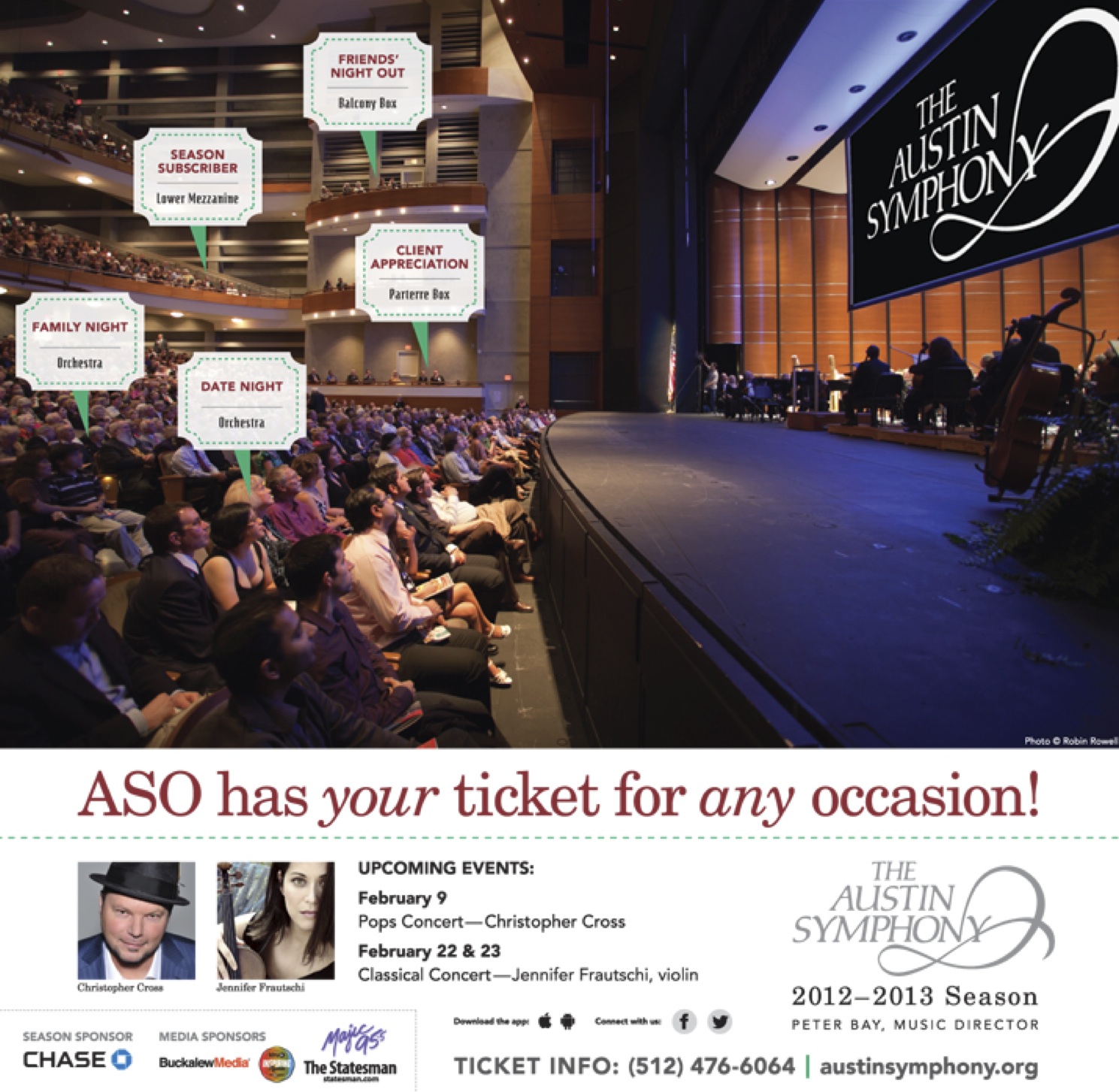
As promised in my last post, here’s another ad from Jason Nicholson at Austin Symphony. I don’t know if it’s a good ad yet because we don’t have numbers to go on. It was developed for the local daily newspaper and Jason hasn’t yet been able to draw a direct causal line between its placement and incremental sales – which is fine. Mass market ads can’t always be tracked for measurable ROI.

AustinSymphony-2

I will describe several things I really like about this ad, though, because it’s an extraordinary illustration of some of the strategic directions we’ve been discussing on this blog.

The most striking thing about the ad is that it devotes promotional real estate to the audience and the product in equal measure. If fact, you can draw a line right down the middle and see that Jason has given exactly half of his attention to his customers. This is a welcome departure from an arts marketing tradition where nearly all photography is devoted to depicting the art, artists and institutions. Most commercial advertisers feature their customers in their ads. The arts should, too.

Also striking is how directly the ad answers the question, “What’s in it for me?” Jason learned through a process of interviewing his audiences that they were moved to buy tickets by different personal, social or professional impulses and he opted to make those motivators explicit in hopes of motivating others with similar impulses (hmmm). Back when demand for classical concert music was strong, we could afford to make ourselves the central focus and allow these motivators to be implicit, but the more dependent we are on non-avid audiences, the more obvious we have to be.

As we were discussing this ad, Jason told me that he always starts with copy that includes the word “you” and that his visual strategy grows from there. Here the copy is clear and bold and the visuals reinforce and amplify the primary you-oriented message. If you’re looking for one simple method for making your marketing more audience oriented, do this: Start every message by saying “you” and let it help you make your marketing more about them.

And, finally, I love the fact that this ad gets attention by inviting viewers to read the little flags above the audience members’ heads. It’s an eye-catcher that grows naturally out of the persuasive strategy and that’s a refreshing alternative to customary arts marketing practices that tend to have no strategic underpinnings, i.e. “Celebrate Live Music!”

Is the ad beautiful? Maybe not. But beautiful and marketing aren’t the same thing. Given the relative ambivalence of new audiences and the intensity of the competition the arts are facing, we may want to opt for effective in our marketing materials and allow beauty to happen when the art and its audiences actually come together.

Is the ad effective? Well, that remains to be seen. Jason has some preliminary evidence to suggest that it’s very effective. But to me, the good news is that he and his ASO colleagues are pursuing an evolving strategy that places audiences at the center of their marketing efforts, which, as any persuasion geek will tell you, is exactly where they belong.

I look forward to hearing more from Jason (He’s got an incredible new season brochure concept in the works.) and I hope to hear from other’s who’ve listened to their new audiences and found ways to break out of the it’s-all-about-us arts marketing mold.

Super Sexy Symphony Ad

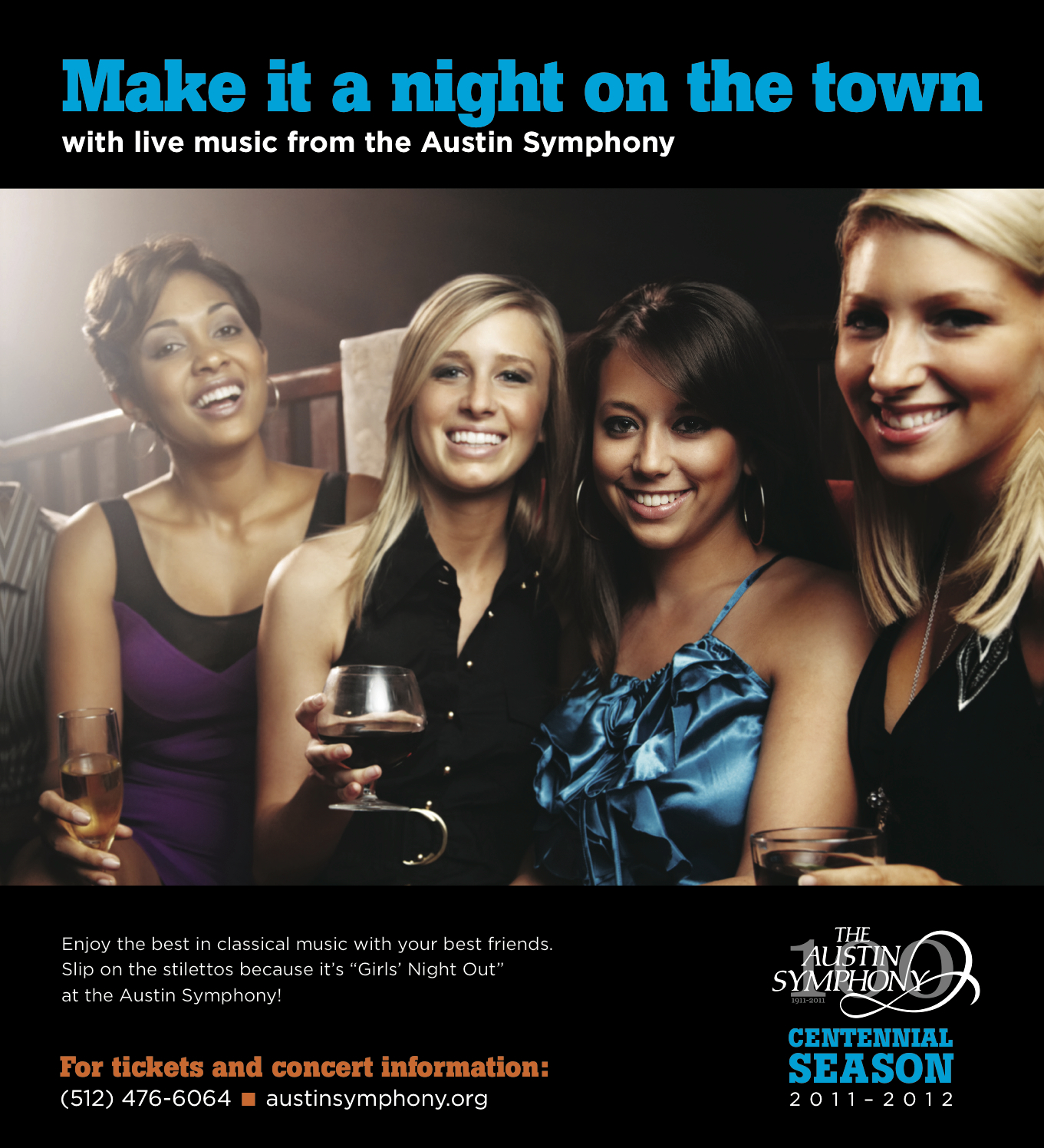
My friend Jason Nicholson at the Austin Symphony Orchestra sent me this ad the other day. I think it’s an incredibly good ad and a great example of what we’ve been talking about on this blog.

ASO AD

My opinion means nothing of course (nobody’s does). The only measure of the quality of this ad is whether it was an appropriate response to pent up needs or wants in the marketplace and whether it actually worked. Fortunately, in this case, my opinion and reality sync up nicely. Jason tells me that he based the ad on research into new audience motives, that he can directly tie significant incremental ticket sales to its run, and that he has a wealth of positive anecdotal evidence to further support its value as a strategic direction.

Jason recognized as a result of a series of interviews he conducted with members of his peer group, and with non-traditional ASO customers in his venue, that the self-centered ads his organization was using were missing the mark. He’d been selling composers and guest artists while his new, young, culturally diverse audiences were shopping for rewarding nights out. So in this ad, which was created for Austin Woman Magazine, he chose to place the emphasis on the audiences he was targeting and opted to sell customer experiences rather than his artistic products.

I’ve written at length about what’s so often wrong with arts marketing and I’m delighted to be able to write about what’s right with this example. Here are some things that I believe make it an approach worth emulating:

It’s not traditional. This was an incredibly bold departure for ASO, as I’m guessing it would be for most orchestras. Jason credits his instincts, the input he got from fence-sitting audiences, and his executive director’s willingness to let him try something new.

It’s about the audience. Look how much of the real estate in this ad is devoted to the audience vs. the ASO. It’s about 85% / 15%. That’s astonishing. Most arts organizations would have a hard time demonstrating that they’ve devoted 15% of their message to the audience let alone 85%.

It’s strategic. Jason made a direct, relevant, motivating connection between what he knew his new audiences were shopping for and what he was selling. Then he crafted a message that made the connection explicit. As I’ve said in nearly every post on this blog, strategic persuasion means knowing what your audiences want and then using that information to describe how your products will make them happy. This ad does that beautifully.

It’s not offensive. There’s not a tuxedo, violin or bust of Beethoven in sight. Because Jason was focusing on his audience’s needs and desires, he was able to bypass all the off-putting trappings that traditional arts marketers use to fluff up their otherwise non-strategic messages.

A word of caution, though, for those who might be tempted to adapt this ad for their market: I’m recommending that arts marketers emulate the process, not the product. You could call Jason to find out where he got the image then simply change the details, but that would be absurd. Jason did his homework. You have to do your homework, too. If your research points in the same strategic direction, that’s all well and good, but if it doesn’t and you’re just copying someone else’s answers, that’s just, well, cheating.

The ad above was one of several in an evolving process. In my next post, I’m going to show you an ad that Jason used in his daily newspaper to appeal to a broader audience. Meanwhile, if you have a marketing message that you developed in response to new audience research, I’d be thrilled to see it and – if it worked – share it with readers.

Do Funders Think Engagement Will Replace Marketing?

I filled out a municipal grant application not too long ago for a choir that sang mostly classical works from European sacred music traditions. The application kept asking how I planned to allocate marketing resources toward under-served communities and I kept saying that I wouldn’t be doing that because the role of marketing is to maximize revenue/participation by spending where the yield will be greatest. To do otherwise in a small nonprofit with severely limited marketing resources would be fiscally irresponsible – and you wouldn’t want us to be fiscally irresponsible with taxpayer money now, would you?

I didn’t say it quite like that but my tone may have implied it.

We didn’t get the grant.

I was reminded of this recently while reading a series of interesting blog posts by Clayton Lord, Diane Ragsdale, Nina Simon, Barry Hessenius, Jim Canales and others (read their posts and and follow additional links). They’ve been talking about how funders encourage grant recipients to support diversity and it made me realize that my experience may not have been unusual.

I’m a marketer so I’m not going to wade into the deep end on this one, but I will say that funders who intend to broaden arts participation through giving would do well to understand the difference between community engagement and marketing. They’re two very different things and to conflate them could have devastating consequences.

Nonprofit marketers have a fiscal responsibility to get the most out of their limited resources by allocating them narrowly and aiming them where they will earn the best return – irrespective of the cultural affiliations of the people who buy the product. Any dollar or work hour that’s diverted from this objective not only diminishes the potential return, but diminishes the long-term impact of the marketing effort and thus the health and viability of the organization. With shrinking audiences and dwindling resources, marketers have enough on their plates without being asked to socially engineer the makeup of their audiences by diverting resources to less productive targets. It’s a straightforward matter of bang-for-the-buck survival.

A healthy community engagement strategy, meanwhile, because it is supported by contributed income, can define its objectives with greater freedom and reach out to culturally diverse communities as determined by the organization’s mission rather than its bottom line. There may be certain resource limitations and performance expectations that serve to focus the effort, but success is measured using a broad range of long-term qualitative criteria, not daily wraps, nightly box office statements or the ability to meet next week’s payroll.

The problem comes, of course, when folks start talking about engagement in terms of audience development. There is little evidence to suggest that engagement strategies can support paid participation at sustainable levels in traditional, earned revenue-dependent organizations, but that’s seldom part of the pro-engagement discussion. Given the nature of the discourse to date, I sense that there’s a belief among funders that traditional organizations can be encouraged to retool their audience development models and become more engagement oriented by shifting the focus of the grants.

And this belief could turn out to be true if engagement and marketing are allowed to work independently, side by side, until the engagement approach proves itself capable of driving sufficient paid participation. But I’m not sure that’s where we’re heading. My guess is that many grant recipients, especially those that fall into the middle area between grass roots and tent pole organizations, will be expected to absorb experimental engagement practices into their existing structures without additional financial support. And when that happens, executive leaders will assume that engagement responsibilities should fall naturally under the audience development, a.k.a. marketing, umbrella.

If I were a marketing director in a midsize arts organization and my ED said to me, “Oh, by the way, you’re going to be responsible for expanding participation from a broader cross section of the community with the same budget and dollar goals,” I’d walk out the door. The scenario may sound overly dramatic, but I’ve worked in the nonprofit world long enough to know just how vigorously the grant application tail wags the organizational dog, and how vulnerable marketing can be to management’s grant-hungry “mission oriented” expectations.

Nina Simon took the liberty in her post of offering recommendations to the James Irvine Foundation, which is at the forefront of this movement, and I’d like to add a few marketing related points for funders who hope to move the industry in a more engagement oriented direction:

1. Define marketing as it relates to engagement using professional marketing expertise from both inside and outside the industry. Make a concerted effort to know in advance exactly what role marketing must play in the industry’s future and where engagement and marketing can safely and productively overlap. If engagement is expected to eventually supplant marketing, project when that will happen and plan to support marketing-dependent organizations during the interval.

2. If engagement strategies are expected to influence paid participation, define exactly how that will work, what the bottom line goals will be, how long it will take for engagement to begin producing measurable results, and how engagement and marketing will balance their respective roles and goals as they work together to grow and sustain audiences.

3. Don’t offer grants that tempt struggling organizations to choose between engagement and marketing or that expect them to carry out both functions in the same space. What most of these organizations need is more professional, more efficient, better focused, quantitative marketing operations.

I’m in full agreement with the direction in which the funding community is moving, but I think it has the potential to turn the reasons for the change of direction into a self-fulfilling prophesy. Some arts organizations aren’t going to survive this transition. We all know that. But it would be a tragedy if funders began presenting options that caused otherwise healthy organizations to falter by forcing them to grasp at inappropriate opportunities.

Do New Audiences Think You’re Nuts?

The ubiquitous Twitterer Howard Sherman called me out the other day for claiming that arts organizations don’t do research. Many do conduct research, of course, so it’s unfair of me to have made such a sweeping generalization.

I stand corrected, Howard.

But I remain deeply concerned about the type of research that arts organizations do and the extent to which the results of that research influence marketing practice. Anyone who’s followed this blog knows that I am convinced beyond the shadow of a doubt that the arts really suck at talking to new audiences. I’ve pointed out on numerous occasions that the content of our strategic communications is overwhelmingly hackneyed, old-fashioned, impotent, insidery and self-indulgent, and that we’ve grown so accustomed to yakking at dying fans that we’ve lost the ability to speak meaningfully to the new audiences on which our futures depend.

When I make sweeping generalizations about research, I’m talking about the kind of research that connects us to the younger, more culturally diverse audiences we’ve been whining about for the last twenty years. I’m talking about research that taps into their yearnings so we can draw motivating connections between what we do and what they want. I’m talking about research that teaches us not what radio stations people listen to, but rather what they need to hear us say so our ads will move them to buy the things we’re trying to sell. If we’re serious about speaking persuasively to new audiences, we have to know them as well as we know our old audiences so the fresh new language they expect to hear comes out of us as naturally as the tired old language that we refuse to stop speaking.

The only hope the arts have for sustaining and growing audiences is a constant supply of new participants, and the only hope we have for motivating those fresh young audiences is knowing what motivates them. The alternative is to sit in our conference rooms imagining what they want, telling them what we think they should want, pretending they want what their grandparents wanted or, God forbid, offering up reasons for wanting us that might not have occurred to them yet. It’s the kind of thinking that gives us crap like this:

Celebrate Spring!

What better way to celebrate than with the unsurpassed joys of live music? From intimate performances of chamber music to majestic orchestral concerts, we’ve got just what you need to refresh your mind and spirit.

Cute isn’t it? Could have arrived in your inbox yesterday from just about any arts organization. But the problem is that it is the polar opposite of strategic communication.

Had the organization that published this done research into what motivates ticket-buying audiences, they’d have learned that there is no pent up desire among potential concertgoers to celebrate spring. And they’d have learned that even if there were such a desire, sitting in a dark concert hall is just about the last place anyone might claim to want to do it. You can funnel ten thousand prospects through a thousand focus groups with hundreds of moderators asking an infinite number of penetrating questions about what people want, and not a single respondent is likely to say anything about celebrating spring by buying tickets to a classical music event.

What they will talk about is personal motivating impulses like enjoying live music, going out with friends, trying new things, drinks and dinner, bragging rights, belongingness, social interaction, inspiration, uplift, personal development and those intangible intrinsic benefits that people feel so deeply but find so difficult to describe. They’ll also talk about the things that turn them off like stuffiness, condescension, expense, exclusivity, inconvenience, artifice, arrogance and alienation. All of this is necessary knowledge for strategic communicators who want to know what they should and should not say.

No strategic message developer armed with such market intelligence would dream of talking about celebrating spring when it has nothing whatsoever to do with what their audiences have told them they want. The person who wrote this obviously didn’t have access to such information and instead decided to use his instincts, insider experiences, creative imagination and agility with poetic metaphor to come up with a fanciful suggestion about what a concert series might do for you if you stopped to think about it – in a certain way, with the lighting just right, an orchestra playing softly in the background, bluebirds flitting about and a soft breeze blowing through the lacy window curtains.

You wouldn’t sit down with a young friend or relative and try to get them to celebrate spring by coming to one of your concerts. They’d think you were nuts. It’s more likely that you’d use what you actually know about them to describe why you think they’d want to spend time and money on your products. “I remember how excited you were the night you heard Arvo Pärt in that club and I couldn’t help thinking this would be something you’d really like.”

The same goes for new audiences. If you talk silly, self-important nonsense they’ll know you’re out of touch with their reality. But if you do research and find out what they actually want, then use that information to bridge the divide between their yearnings and your products, they’re more likely to listen and then do what you so desperately need them to do.

Big data? Great. Pricing analytics? Great. Intrinsic impact research? Eh, I suppose, but none of it can save an organization that refuses to learn how to make rational, direct, personal, relevant, motivating communicative connections with its future audiences.