Arts Marketing Wouldn’t Suck So Much If It Were Like This

I came across this ad for Android devices today.

https://www.youtube.com/watch?v=TRmgMe2STL0

Watch it and pay close attention to these things:

  • The ratio of content featuring customers vs. content featuring the product
  • The fresh, down-to-earth, colloquial, customer-centric language
  • The emotional impact of customers engaging with the product
  • The emphasis on YOU (meaning the customer)
  • The diversity of the customers shown enjoying the product
  • The fresh, professional, contemporary production values

Now go get your last season brochure and pay attention to these things:

  • The ratio of content featuring customers vs. content featuring the product
  • The fresh, down-to-earth, colloquial, customer-centric language
  • The emotional impact of the customers engaging with the product
  • The emphasis on YOU (meaning the customer)
  • The diversity of the customers shown enjoying the product
  • The fresh, professional, contemporary production values

In my last post I drew attention to some shamelessly egocentric marketing materials that were produced by big financially troubled arts institutions (Minnesota Orchestra, Atlanta Symphony, San Diego Opera). This Android ad, by demonstrating so well what good marketing is about, shows exactly why those arts marketing materials are so bad:

  • Their content is entirely about the product
  • Their language is canned, stuck up, artsy and self-centered
  • They tell customers what they should feel rather than showing them how they will feel
  • Their emphasis is on US (meaning the product)
  • There is no diversity of customers shown enjoying the product because there are no customers shown enjoying the product
  • Their production values are stale, amateurish and old-fashioned

Make no mistake. The blame for failing to attract sustaining audiences lies squarely with executive leaders who allow their organizations to do narcissistic marketing.

When troubled arts organizations start developing marketing content that’s about new audiences – and how their products will make those audiences happy – they’ll earn the customers they deserve.
Arts Leaders’ Egos and Bad Arts Marketing

In my last post a reader took issue with my having suggested that executive arts leaders’ egos might have something to do with bad arts marketing.

Please allow me to be more direct.

The egos of executive arts leaders have everything to do with bad arts marketing. Arts marketing sucks because so much of it is developed to feed the egos of executive arts leaders.

The reason arts marketing is overwhelmingly self-centered, self-important and self-aggrandizing is that executive arts leaders with healthy egos and little professional marketing expertise make all the final marketing decisions. Asking an arts executive to approve a brochure filled with shameless self-flattery is like handing a loaded pipe to a crack addict. They can’t help themselves. They don’t really know what professional, customer-centered marketing should look like, and since there’s no one to stop them, they’ll approve the marketing they believe is the best reflection of their organization’s worth. And since the reflection of their organization’s worth is also a reflection of its leaders’ abilities, they will inevitably go for the content they find most flattering.

In the real world, effective marketing strategy begins with the customers and is designed in response to their desires and expectations. Professional marketers develop their strategies to leverage those dispositions, which means keeping their focus on the customers. And executive leaders who manage these marketers know their role is to approve the methods and materials that do this most effectively. Smart business leaders may have personal opinions about marketing, and they may think their products are worth crowing about, but they understand that their job is to let objective market intelligence and rational, customer-centered methods take priority.

In the arts, meanwhile, marketing begins with the products and what organizations want to tell the world about their merits. After various promotional ideas have been mocked up, arts leaders use their professional discernment (a.k.a. personal opinions) to choose what they they think looks best or feels most appropriate or fits best with industry norms and traditions. And since industry norms and traditions consist primarily of inexpert arts leaders choosing the best reflections of their organizations’ worth, self-flattery will always win the day. This dynamic is so much a part of the culture of culture that we as an industry accept narcissistic marketing unquestioningly, as if it’s a given. “Why wouldn’t we boast about ourselves? We’re wonderful! People should know that. And the more wonderful we tell them we are, the more likely they’ll be to want to buy tickets.”

Makes a great dating strategy, too!

This is the point where the executive leaders I’m talking about say,

“Well of course he’s not talking about me. I’m a respected arts executive. I’m too wise, perceptive and accomplished to make such poor decisions. Why, I’m the boss of a big city arts institution; I oversee the marketers so I am automatically a marketing expert. My thoughts on audience development have even been published in the Sunday newspaper! Besides, I’ve been vetting promotional materials for years and doing a damn fine job of it. This chronic decline in audiences has nothing to do with me. Now if you’ll excuse me I have a budget crisis to deal with and artists’ salaries to cut.”

If you’re an executive arts leader who’s in a position to govern your organization’s marketing choices, and you learned what you know about marketing on your way up through the nonprofit arts, it is highly unlikely that you have sufficient professional expertise to save an organization that’s losing audiences. The nonprofit arts are a terrible place to learn marketing and you have undoubtedly learned an outdated, idiosyncratic, mid-twentieth century brand of “promotional” marketing that doesn’t work anymore. Arts marketing is a quirky, tradition-bound, quasi-professional endeavor that bears little resemblance to the full-on professional marketing that successful leaders will need to master keep their organizations alive.

Poor old Ian Campbell thought he was making wise marketing decisions right up until he scuttled the San Diego Opera – for lack of audiences. Leaders at the Atlanta Symphony Orchestra thought they were making wise choices when they approved this bizarre brochure – just before locking out their musicians. And the leaders at the Minneapolis Orchestra no doubt believed their monumentally self-adulatory brochure was the best of all possible choices – to spring back from the brink of disaster. All executive leaders of struggling arts organizations think they’re making the best possible marketing choices – even when they’re woefully underprepared to make those choices and their organizations are falling apart around them.

There was a time when the marketplace was so full of people who wanted what the arts had to sell that we could be as self-centered and boastful as we wanted and people would beat a path to our doors. But the world has changed; there are far fewer avid arts fans out there who find our overly generous self-assessments appealing. Every arts leader has heard this admonition a thousand times, but at some point it has to actually influence behavior: IT’S NOT ABOUT US ANYMORE. You can’t just nod in agreement when people say this at industry conferences and then come home and publish marketing materials that are all about you; you actually have to make it about them.

If you want to sell something to somebody, you have to tell them how it will satisfy their desires. It’s one of the oldest truths known to humankind. But in the arts, we don’t really know who our new audiences are, we refuse to learn what they want, and without knowing what they want, we can’t tell them how our products will satisfy their desires. So instead we blather on endlessly about how wonderful we are – or how wonderful people should think we are – and hope that young, culturally diverse people will somehow magically find us as appealing as traditional audiences once did.

I’m well aware that I’m just pissing in the wind here. Executive arts leaders won’t read this because they just don’t pay much attention to marketing. In my experience they show little interest in learning how to do it well because they’re perfectly comfortable with what they think they already know. (I’ve never seen an executive arts leader at a marketing conference, have you?) You’d think that leaders of an industry that’s facing a catastrophic decline in customers would be rushing out to get marketing MBAs, but no. It’s easier to complain about how poorly the rest of the world is being educated than it is to get the education they need to solve their own problems.

The answer to the arts’ audience crisis is heartbreakingly simple: know your new audiences well enough to understand what they want, and then speak to them humbly and honestly, in a language they understand, about how your products will make them happy. Out-of-touch arts administrators who hole up in conference rooms filling brochures and emails with canned, amateurish, self-congratulatory bombast, and then spraying them at the world in hopes of hitting like-minded fans, simply aren’t going to survive.

‘Monumental’ Adjective Abuse at Minnesota Orchestra

Here are some words that executive leaders at the Minnesota Orchestra like to read about themselves in their marketing materials. All were published in just one post-fiasco season brochure:

Extraordinary, brilliant, celestial, dazzling, festive, stunning, shimmering, beautiful, star-studded, never-to-be-repeated, heavenly, glorious, wonderful, tragic, heartbreakingly, sprightly, treasured, superb, brilliant, monumental, tremendous, thrilling, stellar, magnificent, sensual, shocking, radiant, majestic, lush, enthralling, amazing, phenomenal, shining, beautiful, lush, characterful, stirring, distinctive, triumphal, charismatic, brightest, world-class, priceless, thrilling, most famous, lush, romantic, richly dark, tragic, star-crossed, thrilling, tragic, cinematic, comic, most-popular, utterly charming, gorgeous, stirring, wonderful, famous, remarkable, brilliant, striking, timeless, legendary, wonderful, dramatic, lyrical, dramatic, lovely, illustrious, soaring-voiced, spine-tingling, profound, ethereal, beloved, world’s greatest, fantastic, heartrending, unforgettable, greatest, most soul-stirring, transcendent, exquisite, enchanting, always-zestful, magnificent, deeply spiritual, ground-breaking, exciting, demanding, outstanding, blissful, thoughtful, witty, nostalgic, multi-faceted, fiery, famous, other worldly, stirring, great, distinguished, breathtaking, dancing, lyrical, extraordinary, marvelous, youthful, vigorous, esteemed, exhilarating, dance-infused, wildly popular, inimitable, preeminent, magically, mysterious, triumphant, epic, celebratory, historic, glorious, top-class, revered, hottest, immortal, jubilant, renowned, distinguished, extraordinary, delectable, magical, soulful, distinctive, organic, meditative, powerful, spiritual, romantic, glorious, perfect, special, bubbly, magically, rich, first-ever, stunning, wonderful, exquisite, wide-ranging, thrilling, classic, popular, beloved, festive, extraordinary, imaginative, stunning, phenomenal, captivating, beloved, ever-popular, timeless, transcendent, greatest of greats, beloved, stellar, multi-talented, uniquely, consummate, monumental, unforgettable, wonderful, glorious, funniest, bona fide, genuine, dazzling, esteemed, riotous, beloved, great, fantastic, heartrending, unforgettable, greatest, most soul stirring, pure, unadulterated, historic, legendary, glorious, extraordinaire, wondrous, beloved, lively, famous, popular.

Here’s a word that describes the professional qualifications of executive leaders who would approve this much hyperbole in one piece of sales collateral:

Dubious.

Here’s a word that describes the marketing team that would produce such a brochure:

Mismanaged.

Here’s a word that describes funders who allow their financially troubled grant recipients to do this sort of amateur marketing:

Irresponsible.

Here’s a word that describes an industry that accepts untethered, narcissistic bombast as acceptable language for public communication:

Leaderless.

And in case it isn’t obvious, here’s a word that describes the seats that might otherwise be filled by new audiences who need to be spoken to in a normal, sane, humble, down-to-earth, customer-centered persuasive language:

Empty.

:::

Maybe Atlanta Symphony Should Lock Out Its Marketing Department Instead

I’ve been reading about the musicians’ lockout at the Atlanta Symphony Orchestra so I popped on to their season brochure to look for clues as to why the organization is having so much financial difficulty. Turns out the clues were plentiful. But first, some basics.

Good sales collateral must meet five specific criteria:

1. It must be developed in response to objective market intelligence. You can’t sell something if you don’t know who you’re talking to and how your product will satisfy their desires, so every good sales message must be firmly grounded in research.

2. It must show how the product will make customers happy so they’ll be motivated to buy. Doing this usually means making the content as much about customers enjoying the product as it is about how wonderful the product is (something arts organizations find almost impossible to do).

3. It must be crafted according to a legitimate persuasive strategy. Sales is a rational process that follows well-established protocols. We know you want X. We sell X. You will buy X. Make sure the first two exes match up, show how well they match up, and you’re golden.

4. It must be goal oriented. A well-designed sales tool leads the buyer naturally to the close with precision, directness and clarity. Every element has a specific job to do relative to this goal. In politics, this is known as staying “on message.”

5. It must balance the desires of multiple market segments in proportion to their value. If the organization is not attracting sustaining audiences, the sales tool must place increasing importance on appealing to new audiences.

So with this in mind, let’s take a look at the brochure that Atlanta Symphony Orchestra used to sell what has become their abbreviated 70th anniversary season.

1. You should be able to tell what an organization’s research has taught them by looking at their sales materials: “It’s obvious that the people of Atlanta said they want X because this sales material is so obviously selling X.” Apply that scrutiny to this Atlanta Symphony Orchestra brochure, however, and you’ll have a hell of a time figuring out what the ASO thinks it knows about its customers.

“It’s obvious that the people of Atlanta said they want:

  • Naked flying sylphs sporting red ribbons.”
  • To be seduced by a local nonprofit arts organization.”
  • A smorgasbord of educational trivia about artists and their works.”
  • A bunch of random descriptive words.”
  • Guest artists with interesting faces.”

I’ve sat in on a lot of focus groups over the years and have never heard an arts audience ask for these things. Usually they talk about themselves and their desire to enjoy enriching entertainment events as part of a broader social experience.

2. The brochure contains over fifty photographs and images, not a single one of which depicts customers enjoying themselves at a concert. Fully half of these could be dedicated to showing audience members having a good time without sacrificing the orchestra’s desire to remind everyone how wonderful and important they are.

3. If there is a rational persuasive strategy at work here, it is obscure at best. If I were to describe the strategy based on what’s evident, it would go something like this: “Let’s come up with a catchy thematic through line based on what we think people should know about us and design a sexy, attention-getting, upbeat vehicle for delivering what is essentially the same content we send out every year. Important goals will include being creative, following tradition, telling everyone how wonderful we are and coming up with something that senior leadership will approve because they find it flattering and comfortably familiar.”

4. If the goal is to get customers to go online and buy tickets, it is difficult to imagine how most of this content furthers that goal. Much of it is way off message including the thematic through line (unless focus groups said they were yearning to be seduced), the stand-alone descriptive words that seem to have no integral connection to the rest of the content, and the chatty, didactic show blurbs, which were clearly not written by a professional communications strategist in support of an overarching, goal-driven message strategy.

5. This is a rigorously traditional brochure that speaks almost exclusively to traditional audiences using the imagery and language that traditional arts audiences are accustomed to. If new audience research has revealed a different set of desires and expectations among future audiences that points to a different set of images and a fresher, more relevant, audience-centric language, there is little evidence to suggest that this brochure content has been balanced accordingly.

Presumably, the Atlanta Symphony Orchestra’s labor issues are the result of the same underlying forces that are affecting orchestras everywhere: diminishing audiences and diminishing community support. But if the organization is using amateur, old-fashioned, self-centered marketing practices that fail to produce desired results, it seems counterproductive to lock out the artists when locking out the administrators who make bad marketing decisions would probably have more productive long-term consequences.

You’re Too Stupid To Know What You Want: Buy Now!

I’ve often stated on this blog that good marketing requires us to know what our customers want. It is a fundamental principle in marketing and a bedrock truth in persuasion. Aristotle codified this truth over 2500 years ago and smart people have been using it productively ever since.

Kyle Clausen reminded me in a comment on my last post, however, that this truth is something arts leaders often find bothersome and would just as soon ignore:

“Arts organizations feel it is their duty to give the world not what they want, but to push their boundaries and limits and give the audiences what they don’t yet know they want.”

Sounds great. Very noble and generous. But replace just one small word and the whole idea is exposed for the presumptuous nonsense that it is. “Arts organizations feel it is their duty to sell the world not what they want, but to push their boundaries and limits and sell audiences what they don’t yet know they want.”

Here’s another bedrock truth: People don’t buy things they don’t want because some aloof, condescending, we-know-better-than-you arts organization told them they should want it. Traditional arts organizations are increasingly marginal, irrelevant and unpopular and, thanks to nonstop media coverage of conspicuous failures, everybody knows it. Arts pros who run these organizations and who think they’re well-positioned to tell people what they should want are either hopelessly out-of-touch or delusional – or both. And when they try to tell people what they should want in communications that are meant to sell tickets, they’re committing an especially tragic and painful – not to mention obnoxious – form of organizational suicide.

The only way to sell arts products to new audiences is to know who those audiences are and what they want. Armed with that information we can explain how our art will satisfy their yearnings and, in so doing, motivate them to buy. Marketing is a process of motivating behavior by leveraging desires. If we don’t know what those desires are, we can’t use them to motivate behavior. And, believe it or not, you can’t motivate behavior by trying to leverage desires that people won’t have until after they buy the product.

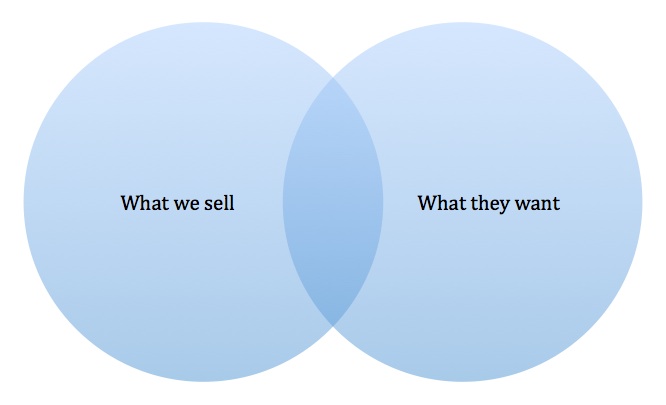
Here’s where arts pros who don’t understand marketing tend to get confused. Learning what new audiences want doesn’t mean we have to start selling them crap, it means finding the overlap between what they want and what we sell so we can establish a meaningful connection. It’s not about pandering, it’s about identifying an optimal context for effective communication. It’s about finding a common language based on mutual interests – one that new audiences are most likely to find persuasive.

Venn 2

In this diagram, the first circle includes all the ways our products satisfy, and the second circle includes all the things that new audiences say they desire. The place where these two circles overlap contains all the information we need to motivate new audiences to participate by convincing them that our products will satisfy their yearnings. But if we never learn what’s in that second circle, we’ll never discover the place where what we sell and what they want come together. And if we insist on filling the second circle with what we wish were there, or what we believe will appear there if they decide to participate, the information in the overlap will be meaningless and motivationally impotent.

Arts professionals who refuse to learn what new audiences want because they prefer to focus on what arts insiders believe they should want – and who make their marketing decisions accordingly – are a danger to their organizations and a detriment to this industry. If we have no respect for the legitimate desires that new audiences already have, independent of their exposure to our art forms, we can’t complain when they ignore the self-important, self-flattering bombast that we insist on publishing in our promotional materials.

The day we decide to engage humbly with new audiences and start learning – with sincere curiosity – about their needs, wants and desires is the day traditional arts organizations will stop hemorrhaging customers and start climbing back on the path toward health and sustainability.

Only then will we be able to help new arts audiences develop healthy and enduring longings for all the wonderful things they may not have known they wanted.

Three Questions Competent Leaders Ask in Marketing Meetings

In my last post I suggested that when it comes to marketing, most arts leaders lack basic competence. I don’t mean this as an insult; it’s a simple description of reality. When compared with the broader marketing profession, arts marketing is an insular, amateurish, old-fashioned enterprise, and since most executive leaders learn what they know about marketing as they rise through the the nonprofit ranks, they arrive in their positions sorely underprepared to make professional marketing decisions.

This is why the arts are in so much trouble. The people who lead the industry, and who presume to make its ultimate marketing choices, don’t know enough about the way real marketing works to attract sustaining audiences.

imgres-1You don’t have to be a marketing genius to lead a well-marketed organization of course, but you do need to know some fundamentals and you need to have some management tools at your disposal to avoid perpetuating the industry’s counterproductive traditions. Most of all, you need the wisdom, humility and self-restraint to avoid inserting your own amateur opinions into the marketing process. This may come as a bit of a shock, dear executive arts leader, but you don’t get to have final say anymore just because you’re the boss. That’s not the way marketing works in professional settings.

So if you’re an arts exec who lacks a legitimate academic or professional background in marketing, but wishes to guide your organization in a more productive direction, here some tools you can use in your marketing meetings that will help you lead your staff toward unprecedented results:

THREE QUESTIONS COMPETENT LEADERS ASK IN MARKETING MEETINGS

1. What do we know?

Effective marketing discussions begin with a thorough examination of what the organization knows about its situation and its markets. A good leader will expect her team to come to meetings prepared with abundant factual data describing a broad range of internal and external realities. At a minimum this will include detailed sales figures and plenty of market research results.

Arts marketing ends up being amateurish because it’s so often driven by insiders’ opinions rather than by objective, external facts. If you want to do professional marketing, banish opinions entirely from the process (especially your own) and focus exclusively on what can be known. A good way to do this is to strike the phrase “I think…” from all meetings and insist that participants begin their contributions with “We know…” instead. (The first few such meetings will be conspicuously brief.)

For most arts professionals this will be agonizing. Collecting accurate, useful data is hard work and poring over dry figures for thirty minutes before looking at designers’ mockups isn’t fun. But if you develop the habit of acquiring and thoroughly analyzing objective data at the beginning of each meeting – without giving in to idle speculation – you will be far more successful. (I adopted this habit working for Disney and last time I checked they were doing pretty well.)

2. How does this work?

Marketing is a process of understanding what consumers want and then motivating them to act by describing how your products will satisfy their desires. It’s a bedrock formula that underlies all effective persuasion. The only way to know if your marketing works is to ask if it fits this formula, so a reasonable answer to the question might sound like this:

We know from our focus group research that younger audiences are looking for peripherals that enhance the concert experience such as drinking and socializing with peers. The campaign we’re presenting today features photos of the target demo having fun and enjoying drinks in the lobby bar. It works by allowing younger audiences to see themselves enjoying time with friends as a part of the concert experience.”

Amateur arts marketers usually can’t describe how their marketing works because they don’t follow this formula and they haven’t gathered the objective data they need to know what their target demo wants. You can’t describe how marketing works if it hasn’t been created in response to your customers’ stated desires. And, needless to say, if your content was created in response to what you think people want, or assume people want, or hope people want, rather than what they actually told you they want, it’s amateur bullshit.

The more time and energy you spend focusing on what you know to be true about your audience’s desires, the easier it will be to create marketing that motivates them – and the easier it will be to describe how it works. (Note: You’ll have to know exactly who your potential audiences are and you’ll have to do research to learn what they want.)

What will it do?

Good marketing is predictable. If you know what your target audiences want and you make smart, rational choices in demonstrating how your products will satisfy those desires – and you do it repeatedly – you will be able to project results with surprising precision. A reasonable answer to this question might sound like this:

We know from our focus group research that younger audiences are looking for peripherals that enhance the concert experience such as drinking and socializing with peers. The campaign we’re presenting today features photos of the target demo having fun and enjoying drinks together in the lobby bar. It works by allowing younger audiences to see themselves enjoying time with friends as a part of the concert experience. We are projecting an 18% increase over last season in this demo based on the quality/consistency of our research findings and year-over-year trending from similar past strategies.

Marketing results can’t always be pinpointed to the penny, but the more facts you use at the beginning of the process, and the more rational methods you apply in the content development phase, the more accurate your projections will be. Compare this to the traditional method, which involves having a group of well-meaning but under-informed insiders sitting in a conference room guessing what people want and dreaming up creative ways to tell them about upcoming events, and you’ll see the difference between amateur and professional approaches.

Arts administrators have long believed that marketing is a creative endeavor that’s well suited to smart, clever, creative people, but that’s just self-indulgent nonsense. Marketing is a science where creativity and the opinions of the organization’s highest-paid person are of severely limited value. The day the arts embrace marketing as a rational, fact-based, professional enterprise is the day that audiences will stop disappearing and traditional arts organizations will begin growing again.

But that day won’t come until arts leaders stop pretending to be marketing experts and begin letting facts and rational methods guide their choices.

If that day never comes, arts leaders have only themselves to blame.

If You Wouldn’t Let Your ED Conduct The Orchestra, Why Let Him Make Marketing Decisions?

No respected classical music institution would ask its executive director to conduct the orchestra. There might be a few rare instances where executive leaders have the necessary talent and expertise, but in most cases, the executive director has not been trained to be a professional musician, has not earned enough professional experience to lead an orchestra, and has not developed the professional acumen necessary to occupy such a position.

Oddly, however, classical music institutions regularly ask their executive leaders to make marketing decisions. There might be a few rare instances where chief executives have the necessary talent and expertise, but in most cases, the executive director has not been trained to be a professional marketer, has not earned enough professional marketing experience to lead a marketing team, and has not developed the professional acumen necessary to be the arbiter of an institution’s life or death marketing choices.

Marketing is a professional 9A MOVIES08discipline that’s complex and difficult to master. Like conducting, it requires years of study, extensive practice, broad experience across multiple styles and genres and in-depth knowledge of theory. Those who rise to the top of the marketing profession tend to possess unique talents and insights along with extensive track records that support their elevated positions. And those who achieve expert status have accumulated, or will insist on accumulating, vast amounts of objective, external evidence to support their opinions. True experts will readily admit that in marketing, as in conducting, what matters most is not what you think, but rather what you know.

Meanwhile, in the arts, all it takes to become a marketing expert is to have the words ‘Executive Director’ printed on your business card. It is a time-honored tradition in the arts to allow executive leaders to make marketing decisions using only their personal opinions and nonprofit experience as guides (aka the “Think Method”). As an industry we absolutely suck at attracting and keeping sustaining audiences, yet we refuse to recognize that what our executive leaders think they know about marketing and what is actually true about marketing are often entirely different things.

If you’re an executive leader who has no legitimate background in professional marketing and whose experience is limited to what you’ve gleaned on your way up through the nonprofit arts, you have a fundamental responsibility to refrain from inserting yourself into the marketing process. What you’ve learned about marketing in this industry is of highly questionable value, and what you think doesn’t matter. If you don’t know enough to make the best possible marketing decisions, you owe it to your organization, your audiences, your funders, your colleagues and your community to learn what you need to know or get out of the way.

Professional marketing is the only way to build the audiences that most traditional arts organizations will need for survival. At some point we have to stop letting amateur executive leaders who don’t really know what they’re doing make all the decisions.

Shrink-to-Fit Audience Development; Why Didn’t I Think of That?

I was wrong. Time to admit it.

Regular readers know that I’ve been picking on San Diego Opera lately for what I thought was their embarrassingly amateurish approach to post-crisis marketing. But as it turns out, I missed the mark by a wide margin.

I humbly apologize to San Diego Opera – and any other organization that might have felt unfairly criticized – for having failed to understand that new audiences aren’t worth the effort.

I learned of my misguided thinking when The New York Times praised San Diego Opera in a puff piece the other day about the company’s brilliant survival strategy. As it turns out, attracting new audiences has nothing to do with it. I’ve been preaching for years that new audiences can be found and that they’re necessary for survival, but as The New York Times article seems to suggest, survival isn’t about growing arts audiences, it’s about shrinking organizations to fit available demand. The most sensible choice a troubled arts organization can make, apparently, is to stop trying to attract new audiences and start downsizing when traditional audiences disappear.

Yes. I’m surprised, too. It’s so easy. All this time I’ve been thinking that we should be growing arts audiences when the answer has been staring us in the face all this time: Screw new audiences. The easiest thing to do is maintain the status quo, stay focused on old audiences, die along with them, and sit back and let The New York Times pat us on the back for our accomplishments. Why didn’t I think of that?

So please allow me to modify my core recommendations to fit this bold new way of thinking:

Don’t Change

Change is difficult, especially for arts organizations – and especially for older arts leaders. Rather than responding to changes in the marketplace, as real businesses do, it’s easier to keep doing the same things you’ve been doing for the last thirty years and hope for better results. And when traditional methods no longer work, give up.

Don’t Try to Attract New Audiences

Attracting new audiences means changing cherished traditions and upsetting entrenched organizational cultures, so it’s something you’ll want to avoid at all costs. You can talk about new audiences because the funding community eats that shit up, but actually building new audiences would require change and hard work. The easiest way to avoid having to fill empty seats is to reduce the number of seats you have to fill, so if the going gets tough, get a smaller venue.

Don’t Hire Professional Marketers

Professional marketers are a huge pain in the ass. They may know how to develop new audiences, but they want to change comfortable old traditions and they don’t fit our organizational cultures. It’s much easier to cut costs by firing amateur arts marketers than it is to hire professionals and put up with having to sell all those tickets.

Keep Up the Self-flattery

Constantly boasting about how wonderful and important you are may be off-putting to new audiences, but it helps older arts leaders maintain a fragile delusion about the relevance of their art forms (i.e. “We must be wonderful and important because it says so in the brochure I just approved.”). Focusing on audiences will force you to learn what young, culturally diverse people really think, and that’s something you definitely don’t want to do.

Get a Job in a Growth Industry

Downsizing in proportion to diminishing demand means that good arts jobs will steadily disappear over the next couple of decades. If you’re young, smart and talented and want have a productive, long-lasting career, don’t waste time on an industry that’s given up on new markets. Instead, find a growth industry and work with forward-thinking people who are committed to building something of lasting value.

:::

Whew! There’s something oddly liberating about surrendering to cultural sector inertia and allowing external forces to have their way. I don’t know why I’ve resisted it for so long. It’s so much easier and we don’t have to worry about persuading young people to care about dying art forms anymore.

According to Marc A. Scorca, president of Opera America, San Diego Opera’s shrink-to-fit survival strategy is good news. If The New York Times thinks such news is fit to print, who am I to argue?


Why Not Just Sell The Friggin’ Tickets?

I’ve been thinking a lot about community engagement lately and have decided that, for large ticket-sales-dependent organizations, it is a colossal waste of time and resources. All the energy and money that community engagement might require of these organizations would be better invested in developing new outside sales initiatives.

What most struggling arts organizations need is to sell more tickets. Sales does that. Community engagement does not.

Engagement is a great idea for small, low-budget, well-funded grass roots organizations that cater to localized community interests and don’t need to earn a lot of revenue, but it’s not going to do much for the big guys – certainly not in the area of audience development. Sadly, it’s being sold to all arts organizations as a solution to their audience development problems when, for the larger institutions, it is no such thing. In many cases, community engagement is a false promise that desperate, highly suggestible arts leaders are buying into because they don’t know how to sell tickets and they don’t know where else to turn. And, tragically, while they’re chasing this elusive dream, they’re neglecting more fiscally responsible alternatives.

The easiest way to develop audiences is to identify people who are likely to want to buy tickets and then go out and sell them tickets. It’s the simplest thing in the world. Unfortunately, arts organizations tend to suck at doing it.

Most arts organizations emerged in a world where there were a lot of people who wanted to buy tickets, so all they had to do was promote their events and wait for the phones to ring. That world doesn’t exist anymore, of course, but arts organizations haven’t figured out how to make the transition. When promotion no longer works, you have to sell, which means you have to reconnect with your community and convince people that it’s in their interest to participate in the art you want them to buy.

Ironically, sales and community engagement are identical processes, with one important exception: Sales has quantifiable goals. Both require personal interaction with the community, nurturing of trust and good will, development of mutually beneficial long-term relationships, honest give-and-take that enables collaborative evolution and a meaningful, institution-wide commitment to the process. But in community engagement, the relationship is the goal, whereas in sales the relationship is expected to deliver useful results. Both are noble pursuits, but only one puts butts in seats and cash in the coffers.

So, if you have the staff and resources to do community engagement, and your survival depends on selling tickets, the smart thing to do is devote those resources to sales because sales will deliver larger audiences and more revenue. Community engagement might be a nice idea, but for ailing arts organizations, doing nice things without doing smart things is irresponsible and counterproductive. Good community relationships can’t save arts organizations that neglect to sell enough tickets to keep the doors open.

If you work for or run a large, ticket-sales-dependent organization, the next time someone tries to convince you that community engagement is the answer to your audience development problems, listen patiently to their lofty advice, attach dollar goals the minute they’re gone, focus on people who are most likely to buy tickets and get used to calling it sales. You can call it engagement on the grant applications if that’ll make the foundations happy (they don’t know anything about selling tickets), but on the ground where it matters, say sales, do sales, and stay focused on selling.

If you do it the right way, all of your community engagement and sales goals will be met.

San Diego Opera Presents a Short White Man in a Brown Suit

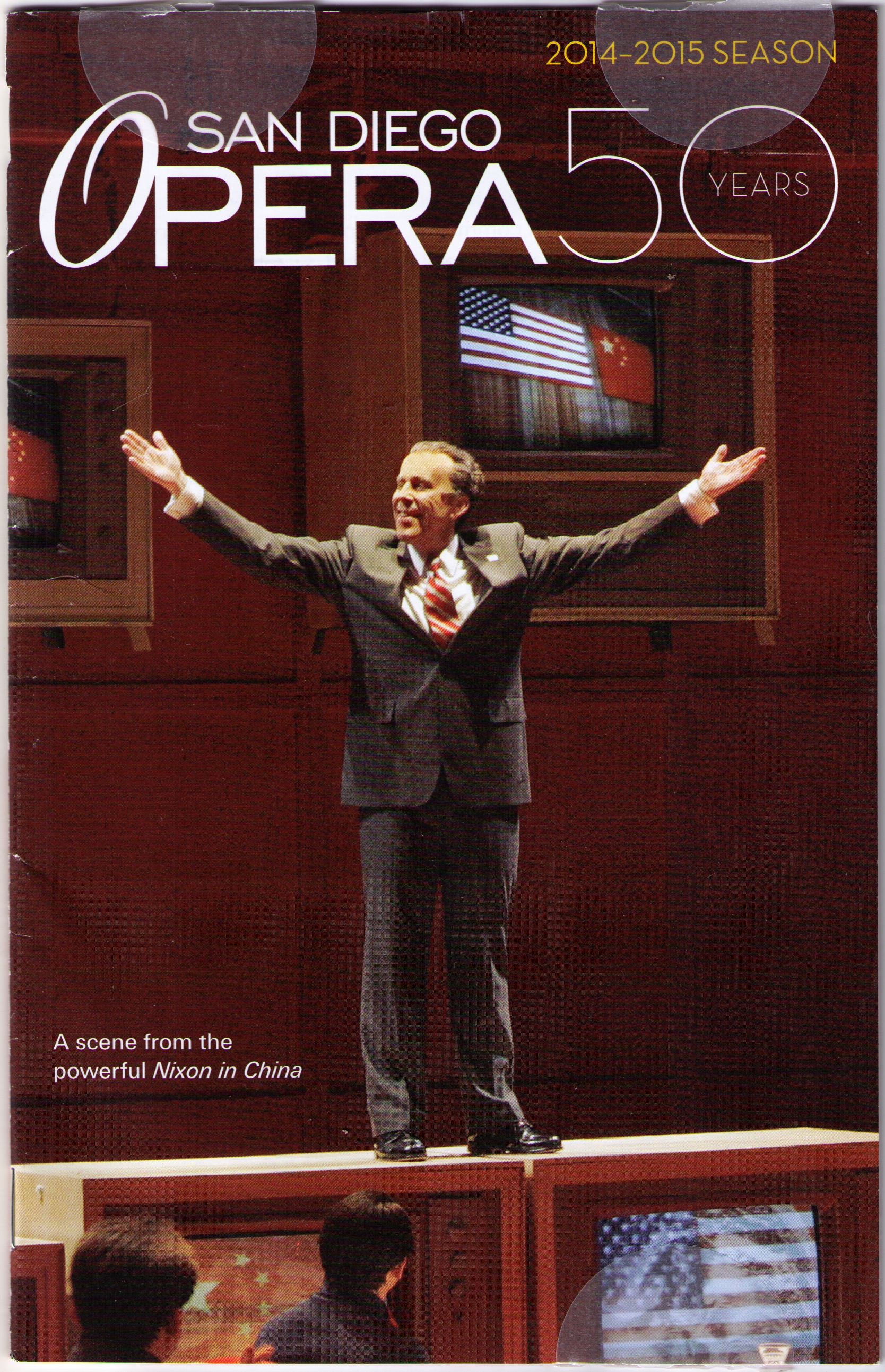
I got San Diego Opera’s season brochure today. It doesn’t seem to be posted online so here’s a scan of the cover.

SDO Brochure


I can only assume that SDO’s research revealed an untapped demand for short, middle-aged white men in brown suits raising their arms and smiling because that’s the graphic image they chose to:

  • Reintroduce their brand as they emerge from their world-famous near-death crisis
  • Send a clear signal that they’ve learned a hard lesson and made sensible changes
  • Convey the emotional, artistic and entertainment value of their season offerings
  • Make the brochure stand out competitively from all the other junk in the mailbox
  • Motivate younger, more culturally diverse ticket buyers to open the brochure and respond positively to its content

The picture is a shot of an opera singer playing Richard Nixon. I can’t believe I have to say this, but a photo of a middle-aged guy playing Richard Nixon who doesn’t actually look like Richard Nixon, and who is doing nothing more than spreading his arms out and smiling on an empty stage may not have been the best choice for evoking the responses that would motivate fence-sitting entertainment seekers to buy opera tickets.

Just sayin’…

I know. It’s Nixon in China. Opera insiders will get it. But San Diego Opera nearly tanked because insiders were dying and outsiders weren’t buying tickets. If you want an excellent example of why outsiders weren’t responding to San Diego Opera’s marketing, you couldn’t ask for a better example than this brochure. And, tragically, this brochure was produced after the company’s near-fatal audience crisis.

The solution to SDO’s audience problems is professional marketing, but for some reason they’ve chosen to do the same amateur marketing they’ve always done and hope for better results. Professional marketers would have conducted research into the attitudes, expectations and desires of potential ticket buyers and then crafted content that leveraged those desires to motivate customers to buy. Professional marketers would have started with what the audiences said they wanted and then reflected their yearnings in the marketing materials.

“Our focus group research into persuadable audiences revealed a powerful pent up desire for artful leisure entertainment experiences that are centered on short, middle-aged white men in brown suits raising their arms and smiling. Thus, we’ve chosen as our principal motivating image a photograph of a short, middle-aged white man in a brown suit raising his arms and smiling.”

Clearly, this research never happened. Had it happened, persuadable audiences would have revealed what they were looking for in their leisure entertainment options, and the desires they expressed would have had nothing to do with short, middle-aged white men in brown suits raising their arms and smiling. More likely, they’d have talked about special evenings out that they can share with friends or family enjoying drinks, food and high-quality live performances. And if that were the case, among all the possible ways that this brochure could reflect how San Diego Opera satisfies those desires, a photo of a short, middle-aged white man in a brown suit raising his arms and smiling would never have been a viable consideration.

No, if history is any guide, this brochure was crafted by a group of opera company insiders based on “that’s the way we’ve always done it” traditions and without the benefit of objective, external market intelligence or professional marketing expertise. It’s the same amateur process that arts organizations have been using for decades, and it’s the principal reason why they’ve been failing to attract new audiences.

Will the brochure work? Yeah, probably. SDO will almost certainly get better results this season, but it won’t be because of this brochure. They’ll sell more subscriptions this year because of all the “we almost died” publicity they’ve been getting – like the three-legged dog everyone wants to adopt because it was found half-dead on the freeway and then written up in the San Diego Tribune.

But threatening to go out of business every year isn’t a practical marketing strategy so unless they come up with a more dramatic publicity stunt next season, SDO will need to find more strategic, professional, dependable ways to sell tickets. Sadly, If they weren’t inspired to do it this year when the stakes were so high and the entire world was watching, it’s hard to imagine they ever will.

Coming as it does at this moment in history, this brochure suggests that individual arts organizations may not have the will or capacity to save themselves. It also suggests that industry leaders are incapable of useful intervention, and that funders are blindly underwriting ineptitude.

Someone who’s in a position of authority should be helping failing arts organizations do a more professional job of earning revenue and attracting sustaining audiences. At the very least they should be calling them out when they refuse to change in the face of life-threatening challenges. But I don’t think there’s anyone in arts industry leadership who knows enough about the difference between professional, audience-centered marketing, and the amateur, self-centered marketing that arts organizations do, to make a difference.

It’s not brain surgery; it’s just knowing the customers well and making sure the marketing speaks to them in words and images they’ll respond to. Smart businesses do it all the time.

If arts organizations aren’t smart enough to do it, maybe they deserve to fail.