
Any arts organization that wants to sell more tickets can do so quickly and inexpensively by employing these basic sales principles:
- Know your customers
- Demonstrate how your products will satisfy their desires
- Close the sale
But in the arts we employ a less customer-centered, more passive promotional approach that looks like this:
- Assume what audiences want (or should want)
- Tell as many people as possible how wonderful and important we are
- Hope that those who agree will respond
There are exceptions, of course; telemarketers use sales techniques all the time. But arts marketing is by and large an under-informed, self-centered, uni-directional process that consists of spraying self-congratulatory bombast at the world and hoping enough people still care.
“Hey, whoever you are: Lookie here! We’re the best thing ever. Even The New York Times thinks so. Look at all these colorful selfies of us doing this rare and special thing! And if you’re smart enough, and rich enough, you can come see us do this in person.”
This is not complicated stuff. Any Girl Scout can tell you that the key to selling cookies is to ask your customers which ones they like best, remind them how happy they’ll be with a few boxes of Thin Mints in their freezer, and don’t let them get away without taking the order.

If the arts sold Girl Scout cookies, we’d send out overblown emails bragging about the superlative qualities of our culinary achievements and telling condescending stories about the history of the art of baking. “The essential motif in this compelling morsel of transcendent deliciousness comes from mentha, or mint, a genus in the family Lamiaceae, which was a popular ingredient in Hungarian folk traditions.”
If you want to sell tickets, you have to learn what makes your event attractive to the customers. And if you bother to ask them, they’re likely to describe a range of motivations that are all about them, that are mostly about the personal benefits of enjoying artful entertainment events wth friends or family, and that have comparatively little to do with the self-indulgent stuff you put in your brochures.
And if you’re lucky enough to learn what motivates your customers to buy your product, that’s what the content of your marketing should be about.
Arts marketers are like Girl Scouts who don’t bother asking which cookies their customers want and then spend all their energies lecturing about the cultural history of Do-si-dos to people who just want to scarf down a box of Thin Mints on their way home.
 As for those looky-loos, I think if they’re looking, they’re fair game, but aggressive luring is a tricky business. We tend to station the marketing team along a perimeter around the theatre and position a guy on the roof who shouts “CELEBRATE” every few minutes. If someone looks, we squeeze the perimeter until they’re forced up to the box office window. If they don’t want to buy, we start screaming “SUBSCRIBE NOW” as loud as we can until they’re lured into submission. It’s effective, but once again, expensive and hard on the old vocal chords.
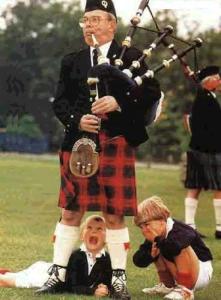 The only reason anyone should ever capitalize the letters A R and T inside other words is if their market research has revealed a tendency among less avid patrons to be motivated by graphics that contain artsy wordplay. I’ve been doing market research for thirty years and have never once heard a respondent describe such a motivation.
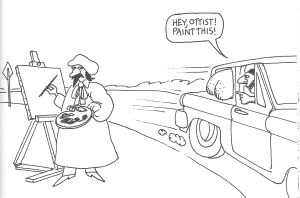
 MARKETING THE ARTS TO DEATH