If Industry Leaders Don’t Get Marketing, Is There Any Hope?

Audiences for traditional art forms such as classical music, theatre, opera, ballet, fine art, etc. have been declining steadily for decades. If the decline continues – and there’s not much evidence to suggest that it won’t – venerable arts institutions that we now take for granted will eventually falter and die. One need only glance at daily arts headlines to know the process is well under way.

Solving the problem is relatively easy, but it requires leadership that appears to be in short supply.

Reversing audience declines and building dependable future audiences demands sophisticated, professional, audience-centric marketing practices, but the cultural sector clings to a marketing tradition that’s simplistic, amateurish and self-centered. We don’t market effectively because we don’t do marketing the way it’s done outside our artsy bubbles. We may be OK at marketing to the audiences we have, but we stubbornly resist learning how to market to the audiences we’ll need when the ones we have are gone.

A broad view of marketing in the arts reveals a troubling deficiency. Marketing expertise has never been a prerequisite for becoming an arts leader so most arts leaders don’t actually know much about professional marketing. Some arts marketers know professional marketing, but most learned their craft inside the bubble and thus merely perpetuate insular industry traditions or strive to appease executive leaders who don’t know what they’re doing. And the greatest tragedy lies in the fact that funders don’t understand marketing because it isn’t a part of their world. Funders are probably the only people who have the influence necessary to initiate a shift from amateur to professional marketing practices, but because they don’t do marketing, they don’t know what that means.

Professional marketing at its core is fairly straightforward: Learn what your customers want and then use that information to show how your products will satisfy their yearnings. This has been true since Aristotle first described persuasion 2500 years ago. But take a look at struggling arts organizations and you’ll find a communications approach that grows out of an entirely different strategic imperative: Tell the world how wonderful and important we are and hope that enough people still care to meet our sales goals. (The first words in these two approaches tell the whole story.)

Fifteen Commandments

If traditional arts institutions are going to survive, some person or group that’s in a position to influence significant change will have to step forward, demand a higher level of professionalism across the sector and then help the industry shift its communications focus from being self-important, condescending and boastful to being curious, humble and tuned in to the needs, wants and desires of tomorrow’s audiences. Unfortunately, with so little expertise among executive leaders, so few good marketers rising into leadership positions and a funding community that isn’t equipped to understand the problem, that person or group isn’t likely to arise any time soon.

Building sustainable long-term audiences is the only hope most earned revenue-dependent arts organizations have for survival. Fundraising won’t do it. Cutting artists’ pay won’t do it. Advocating for better public policy won’t do it. Emergency bailouts by deep-pocketed philanthropists won’t do it. New buildings certainly won’t do it. Education won’t do it – not fast enough at any rate. And the community engagement fad, while it’s a lovely idea, won’t do it either. If large paying audiences are the key to survival and marketing is the most sensible, effective way to get them in the doors, using sophisticated, professional, real-world marketing to develop sustainable new audiences should be an ultimate arts industry priority.

The fact that it’s not a priority points to an embarrassing vacuum in arts industry leadership, a bleak future for traditional arts organizations and a devastating loss for the millions of potential new audience members who won’t have been properly persuaded to participate.

The audience problem can be solved. Figuring out where to find leaders who will solve the audience problem, however, is a problem that may have no solution.

The Ghost in the Business Model

Doug Borwick has an interesting post this week where he suggests that vestiges of the partronage system might be lurking invisibly within the management structures of the arts, and that our blindness to these unseen forces could be what’s preventing us from making necessary changes. I think he may be on to something.

Arts pundits talk a lot about business models, but I wonder if the models we can see and describe are big enough to fully characterize what’s going on. What if there really are ghosts of old patronage models beneath the surface? Can we really change our organizations if there are invisible, ancestral operators pulling strings behind the scenes?

I used to do marketing for a large performing arts center where the management priorities often had little to do with contemporary reality and where board-level decision making made it incredibly hard to sell tickets. I was complaining about this to a friend who’d worked there for decades and he launched into a little tirade that went something like this:

“Your problem, Trevor, is that you actually believe the mission statement, which has nothing to do with why we’re here. This place was created by powerful cultural elites to be a playground for cultural elites. That’s its primary objective. The most important thing that happens here is the annual gala. Everything else – the art, the education, the audience – is there to make sure the gala happens every year. This isn’t an arts center, Trev, it’s a friggin’ Mount Olympus and you’re just a nobody mortal who’s here to keep things running so the Gods have a place to play. So stop trying to sell tickets; that’s not your job. You do marketing. Marketing is all about making pretty brochures that major donors can hold up like hand mirrors and say, ‘My, how very attractive we are!’ That’s all anybody wants from you and nobody cares how many tickets you sell. My advice to you is to recognize who’s really running the show and do as good a job as possible at being exactly what they expect you to be.”

“But what if we end up going out of business?” I said.

“Going out of business? Of course we’re going out of business. This place is a dinosaur. But you’re not going to be able to do anything about that, my friend. Mount Olympus itself went out of business thousands of years ago and everybody else got along just fine.”

I thought he was being facetious at first, but had to admit after a while that what he said made sense. The business model I’d been following up to that point said that the mission was the primary objective, that audiences were paramount and that the role of marketing was to sell as many tickets as possible. This was a surprising shift in perspective but it did a much better job of describing how things really worked, and it went a long way toward explaining why I was having so much trouble making my model fit.

It’s not that his interpretation of reality was any more accurate than anyone else’s, or that the Center was a front for a bunch of cynical, self-serving rich people who wanted to dress up and swill champagne at swanky parties for however long it lasted. The thing that impressed me was that he presented a legitimate but obscure alternate metaphor for understanding how the institution operated, one that, depending on your perspective, was as accurate and useful and reflective of reality as any obvious business model that any mortal management consultant might have described.

If we’re going to continue talking about arts business models, we might want to find one that describes not only the evident functional dimensions of our business structures, but one that’s capable of also describing the intangible cultural, historical and maybe even supernatural forces that work in different dimensions and in sometimes mysterious ways to influence how our organizations behave.

Trying to change one without fully understanding the other is probably impossible.

Engagement or Artificial Affectation?

I ate lunch at a Panda Express the other day. When I walked in the door, a young woman behind the counter mumbled something in my direction that I later learned was, “Welcome to Panda.” I didn’t know what she’d said or whom she was talking to, but somebody else came in right behind me and he got the same greeting. As it turned out this gal muttered the same thing to everyone who walked through the door. It was incredibly creepy.

I can’t say what the executives at Panda Restaurant Group, Inc. were thinking when they asked their employees to behave in such a manner, but I’m guessing it was part of an effort to engage with customers. Presumably, this young woman was trying to connect with me personally by saying something she would never say in real life and then repeating it verbatim to everyone else who entered the restaurant. How embarrassing it must be to work there, I thought, and how out of touch those corporate executives must be to think that this was effective policy.

I mentioned this to a friend who’s a regional manager for a huge retail chain and he told me that engagement is as big a fad in the corporate world as it is in the cultural community. Every week, he said, another directive comes down the pike that’s aimed at turning hourly wage earners into more effusive brand ambassadors. “I can’t make my employees do most of this stuff. It’s bullshit dreamed up by MBAs who don’t have a clue who these people are or what it’s like trying to turn them into Disney employees overnight. Engagement is something you are, not something you do just because some genius at corporate sent an email.”

As an arts professional who’s been following the engagement conversation closely, I couldn’t help thinking that my friend’s wisdom might have some resonance in the cultural sector where engagement has moved from being something art pros just talk about (like so many other fads) to something that funders are actively asking grant recipients to do. Asking people to engage is a great idea in theory, but being genuinely engaging may have a lot more to do with the fundamental nature of an organization than with any new criteria the Underbridge Foundation decides to put in its grant application.

Are arts organizations naturally inclined to engage? Some smaller community organizations certainly are, but a lot of mid-size and larger institutions simply aren’t. In my experience, the professionals who run arts organizations are very much “behind-the-scenes” sorts of people who don’t move beyond their insider’s social milieu to engage meaningfully with outsiders. In general, arts professionals tend to respect the walls, doors and prosceniums that separate them from the ordinary folks who visit their venues, and they aren’t naturally inclined to reach out with warm, humble curiosity in an effort to interact meaningfully and generously with the less well-initiated folks who reside outside the bubble.

There’s nothing wrong with being behind-the-scenes people in an industry that needs to have plenty of good people working behind the scenes. We put on shows. We impress. We make magic. And part of the appeal of that magic may very well be the mysterious things that a select group of arts insiders do out of sight of ordinary audiences. The Wizard of Oz wouldn’t have been the Wizard of Oz if everybody knew what was happening behind that curtain.

But a significant problem arises when elite academics, funders and policy pros begin asking people who’ve spent their entire lives behind the curtain to start engaging with ordinary audience members – or else. There are a lot of veteran arts pros, especially in leadership ranks, who are no more inclined to interact personally with the churning outermost fringes of their community support systems than shy high school girls are to shout heartfelt greetings at fast food customers. Asking these folks to save their organizations by relating to regular folks outside the bubble is like asking them to suddenly become different people, and that’s just not going to happen. If arts leaders and the organizations they run were naturally predisposed to engage, they’d be doing it already.

Engagement is not a new department, program, service initiative or tag line, it’s something that must be an honest, organic extension of who and what we are. Walt Disney built an empire that was infused from the outset with his personal impulse to make meaningful connections with ordinary people. If Disney employees are naturally effusive brand ambassadors, it’s because they learn it the day they arrive on the job and they live it every day they work for the company.

Is engagement a good idea? Yes. Definitely. I’ve been an audience engager my whole life and I’ve seen the astonishing things that can happen when arts organizations step outside their comfort zones to learn from and appeal to non-traditional audiences. Will organizations that don’t have engagement built into their cultural DNA be able to do it? That remains to be seen. Virtually all of the engagement work I’ve done was peripheral to the missions of the organizations I worked for and too far beneath the leaders’ social status to be of any personal or even professional interest to them. None of it was an outgrowth of a fundamental organizational impulse to make meaningful, long-term connections with audiences.

I know from experience that engagement can’t be superimposed on an organization that doesn’t have engaging leadership and isn’t guided by a mission to engage.  Elite policy pros who hope to influence meaningful change might do well to avoid trying to initiate tactical-level behaviors and focus instead on nurturing engagement-oriented leaders who are personally committed to making engagement an integral part of their organizational missions.

We’re not selling orange chicken and fried rice. We can’t afford to have engagement become an artificial affectation that customers must endure as they endeavor (if they endeavor) to buy what we’re trying to sell.

Most Awesome Brochure From Austin, Texas

I’ve written before about the great work Jason Nicholson from the Austin Symphony is doing. Today I’m delighted to let you know that his 2013/14 season brochure has been recognized by peers at the League of American Orchestras as the “Most Awesome Brochure” in his category.

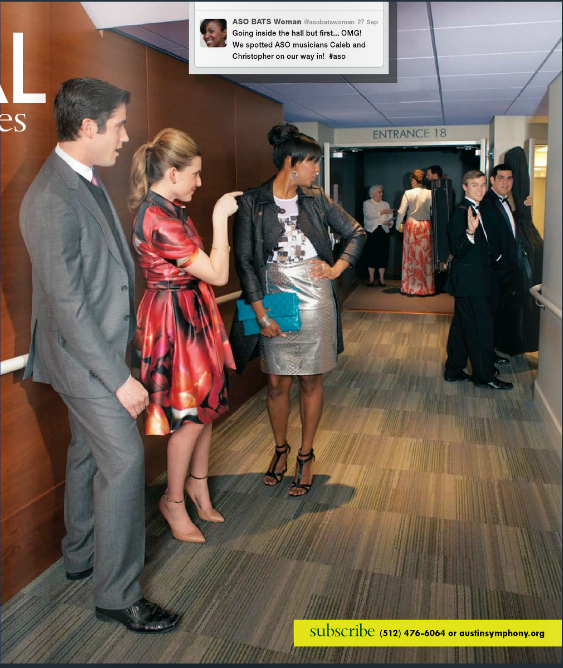
ASO Brochure ShotYou can see the brochure here.

Early reports suggest that the brochure is pulling ahead of last year’s, but we’re waiting for overall results. What we insiders like and what works aren’t always the same thing, of course, so we’ll have to hold off on making judgements until the numbers are in. (Surprising as it may seem to some veteran arts pros, sales results are the only reliable indicators of an orchestra brochure’s quality.)

From a strategic perspective, however, I can identify several elements of this brochure that make it worthy of its awesome designation:

1. It’s based on research into audience motivations. Jason learned from audience members on the outer fringes of his support system that the experience of enjoying a night out was as important as the content of that night out, so he created a brochure that focused on the customers’ experience.

2. It’s as much about the customer as it is about the product. Commercial marketers know that one of the best ways to sell a product is to show happy people who represent their target demographic actually enjoying the product. This does that beautifully. (Larger orchestras that use their promotional real estate to talk exclusively about how wonderful and important they are could learn a thing or two from this.)

3. It tells a story. Rather than simply presenting sequential product information, this brochure tells a compelling emotional story about a couple’s night at the symphony. It uses narrative to draw consumers in and help them identify more personally with the product. That last shot of the happy couple walking hand-in-hand up the aisle under the words “Subscriber Information” is priceless.

4. It breaks the fourth wall. That shot of the patrons and musicians in the same hallway is priceless.

5. It meets the audience where they live. Arts institutions often maintain a philosophical belief that audiences should aspire to their level, which is fine and may be true, but allowing that philosophy to spill into marketing messages can be suicidal. This brochure avoids condescension by saying, “This is about you,” which is exactly what it is.

I’m a huge fan of the work the Austin Symphony Orchestra is doing and I look forward to seeing great things coming from Jason and his team in the future.

Congratulation, Jason. Can’t wait to hear how the campaign works.

Spinning Steve Jobs

Arts professionals who have limited marketing expertise are fond of repeating this quote from Steve Jobs:

“People don’t know what they want until you show it to them.”

It’s only part of the original statement and it has nothing to do with the arts, but cultural community insiders love this quote because it comes so close to expressing one of their most cherished foundational attitudes:

“We know what people should want.”

It’s easy to see how arts professionals might identify with Steve Jobs and believe that they’re in the same business – that of deciding what’s best for consumers – but that’s not what’s happening here at all. Jobs wasn’t deciding what consumers should want, he was anticipating what consumers would want and the difference is monumental.

Jobs actually cared a great deal about what consumers wanted, but he was impatient with research methods that told him what people thought was possible based solely on what they already knew. Here’s the original quote:

“It’s really hard to design products by focus groups. A lot of times, people don’t know what they want until you show it to them.”

Jobs was talking about the development of wildly popular consumer products that anticipated human desires and satisfied them before people had a chance to imagine what could be done. He was incredibly good at this because he had a genius for knowing what people would want before they wanted it. There were no ‘shoulds’ in his business vocabulary; it was all about giving people exactly what they wanted. It was about selling the most products to the widest possible audience. It was about fierce business competition and making money irrespective of whether the products he sold had intrinsic value that transcended the utility, novelty or entertainment qualities for which they became famous.

Arts pros who embrace this quote, however, aren’t talking about what consumers want, they’re talking about knowing more than consumers do about what’s desirable. They’re talking about the universal superiority of their products and a fundamental belief that giving people what they need is more important than pandering to their base appetites. They’re assuming the quote means “people have to be educated about what they want by people who know better” or “people aren’t capable of wanting the right things without us to guide them” or “the things people want when left to their own devices are irrelevant compared to the things we think they should want” and that’s got nothing whatsoever to do with what Steve Jobs was talking about.

Does it matter if arts folks go around misapplying quotes from world-famous tech entrepreneurs? From a marketing standpoint it matters enormously. Marketing is all about knowing what people want so we can best describe how our products will make them happy. If we don’t bother to find out what new audiences want, we’ll never be able to convince them that the products we sell are worth their time and money. We don’t necessarily have to change the art we’re producing to satisfy their most mundane appetites (not yet, anyway), but we do have to isolate the place where what we sell and what they want come together so we can at least communicate in a persuasive language they understand.

Many arts pros find this Steve Jobs quote irresistible because, in their interpretation, it gives them permission to remain dismissive of consumer desires and focus exclusively on the superior attributes of their products. Unfortunately, the language these folks speak to the world around them tends to be self-important, condescending and utterly unconnected to the desires and expectations of the people on whom their futures depend. Look at the promotional materials produced by just about any financially troubled arts institution and you’ll find the sort of untethered bombast that happens when arts administrators haven’t bothered to get to know the new audiences their organizations are talking to.

We’re an old-fashioned niche industry that’s experiencing steadily diminishing consumer demand for products that don’t change all that much. Steve Jobs rode a tidal wave of worldwide popularity by developing innovative products that were designed to feed the market what it was most eager to consume. It would be great if we were using innovative business methods that a genius like Jobs could validate, but if he didn’t actually say something that was applicable to our situation, and we’re not interested in what he actually said, we should avoid claiming him as a kindred spirit.

UPDATE: June 19 at 2:30pm: I published this post this morning and then just happened to see this clip this afternoon. Not totally on point, but nonetheless interesting.

The Revenge of the Bored and Unaware

Diane Ragsdale has a thoughtful piece in her Jumper blog this week about the regional theatre movement, which she fears has crept away from its noble artistic roots in pursuit of audiences and revenue. We’ve been down this road many times, of course, but Diane always manages to add perspective and depth to such discussions, and in this case she’s sparked a conversation that’s truly fascinating to read.

As a marketing professional, I don’t concern myself much with the art vs. commerce debate. It’s been going on as long as I’ve been in the arts and it’s likely to continue long after I’m gone. What I do care about, though, is the effect this discourse has on audience development and Diane’s post reveals an industry attitude that I believe is pure new audience poison. To support her thesis she quotes Zelda Fichandler, who said:

“Nobody was looking for us, peering through the window, watching for us to come to relieve the boredom and unawareness of their lives. It was we who had to teach and persuade them to want what we wanted to give them. And we had to insist on it for their own good, but, really, for our own, if we were honest enough to admit that. … Nobody called us, but we came.”

Then, after repeating the same Fichandler quote, she adds this little gem from Taylor Mac:

“We are here to give people what they need, not what they want.”

I gotta tell ya, as someone who’s spent the bulk of his career engaging with and advocating on behalf of ordinary audiences, reading these quotes made my stomach turn. The presumption is shocking and the condescension is so insulting that I find it hard to believe any arts professional would perpetuate such sentiments let alone defend them on moral grounds. Is it any wonder that new audiences are running in the opposite direction when elite arts insiders continue to talk like this?

Fichandler may have believed that she was rescuing bored and unaware Washingtonians when she arrived to “shape their process of living,” but the reality is that when she and her peers established regional theaters they were satisfying a pent up demand in the marketplace for serious theatre. In the middle of the last century there were plenty of literate, educated, affluent consumers who wanted the kind of theatre that regional theatre artists wanted to make and sell. It wasn’t a triumph of art over commerce, it was a simple matter of demand and supply being, for a time, well balanced. And the subsequent creep away from founding missions that Diane so eloquently laments may have been more of a natural, necessary, appropriate response to evolving market conditions.

We can probably forgive the founders of the regional theatre movement for being presumptuous and condescending because they emerged in a broader culture that, to a large extent, agreed with their point of view, and because they had a solid base of consumer support to back up their claims. But today, there is no such cultural consensus and the simple fact is that regional theatres need audiences more than audiences need them. You can’t sustain an institution by trying to give people what you think they need if the need is questionable and the people don’t already want it. The regional theatre movement couldn’t do today what it did in the middle of the last century because the market doesn’t contain enough demand for the products it wants to sell.

As for the effect this type of thinking has on audience development, the problem with the “you need us because we know what’s good for you” attitude that still lingers – and still shapes the way theatres talk to the world around them – is that it encourages us to speak to our constituents as if they’re bored, unaware, lesser beings who are waiting for people like us to brighten up their humdrum little lives. It’s why, some sixty years later, arts marketing is still comprised almost entirely of self-centered, self-important, self-congratulatory bombast, and it’s why new audiences, who are neither bored nor unaware, find us so unpersuasive.

I know that Diane was arguing for a return to core values, but some of those values may be inappropriate and possibly even detrimental to our current situation. If I were trying to make such an argument, I’d avoid the Zelda Fichandler quotes (which should probably be quietly retired to the Arena Stage archives) and opt for a more audience-centric set of foundational assumptions that goes something like this:

We are not better than the people we serve. We need to learn from the people in our communities how to create art that resonates with their needs and desires. We understand that audience members are fully realized human beings with stimulating lives full of attractive choices, and that our job is to convince them that our products are among the best choices they can make because they offer the greatest personal rewards. We must strive for the greatest common good by working with people in our communities to find the place where art and audiences come together most productively, and we must remain constantly aware of, and be prepared to respond to, changing tastes, attitudes and understandings in the marketplace.

Can Technology Save the Arts?

If you follow ongoing public discourse about the arts, you’ll quickly discover that traditional art forms are losing audiences, that younger, more culturally diverse audiences must be found to replace graying audiences, and that finding new audiences means adopting the technologies that younger, more culturally diverse people use to communicate.

alexander_graham_bell_500pxTry following arts pros on Twitter for a while and you’ll experience a barrage of breathless advocacy for up-to-the-second technological answers to the arts’ most pressing marketing problems. Peruse breakout session schedules for industry conferences and you’ll see that mobile technology is the panacea we’ve been waiting for. Or dive into the blogosphere and you’ll discover that anyone who’s not already on [new social media site name here] is hopelessly behind the curve. If the question is, “How do we build new audiences?” the answer is almost always new technology and, sadly, it’s almost always the wrong answer.

If building new audiences were a simple matter of getting the same old marketing messages in front of younger, more culturally diverse targets, it might be the right answer, but that’s not how it works. New audiences are less interested in the arts than old audiences. If we want to convince them to participate, we need to stop focusing on getting our messages in front of them and start motivating them by talking to them about why they should come. These are two entirely different things and the latter is concerned not with technology, but with the uniquely human process of persuasion.

The accepted language of arts marketing is vapid, trite, amateurish, self-congratulatory bullshit that was developed for patrons who were so interested in the arts that it didn’t matter what we said as long as we gave them the information they were waiting for. But new audiences don’t respond to bullshit and they’re not sitting around waiting for our information. They may not care about our information and their lack of enthusiasm for our products won’t be overcome by novel technology. If we want to persuade them, we have to make a compelling case with direct, relevant, customer-oriented language – and language is not about technology, it’s about content.

The new media world accepts as a truism that content is king, but in the arts we’ve allowed ourselves to believe that digital innovation will somehow render the tedious puffery we publish in our brochures and emails suddenly persuasive – that technology is capable of taking idiotic phrases like “Celebrate the Experience of Live Performance” and delivering them more persuasively to a smartphone in a young hispanic person’s pocket. We’ve allowed shiny new objects to blind us to the limitations in our outdated promotional content and distract us from making fundamental, necessary changes in the way we speak to the world around us.

The answer to the problem is easy and surprisingly inexpensive. It involves knowing who we’re talking about when we say things like younger, more culturally diverse audiences. It involves learning what they want, which means talking to them – and listening to them. And it involves developing a fresh, direct, relevant promotional language that enables us to describe how what we sell will satisfy their yearnings.

Is technology important? You bet it is. It’s the vehicle that will carry our content to its intended recipients, it’s the conduit that will facilitate our loyalty building conversations with new audiences and it’s the convenience factor that will make buying faster and easier than ever before.  And, yes, it can even shape and enhance our message content to make it more appealing and possibly even a tiny bit more persuasive to people who prefer one technology over another. But we can’t allow ourselves to believe that shiny new technology will mitigate the need for thoughtful, strategic, audience-focused new content development.

Asking technology to be persuasive is like asking the mail carrier who drops off the same old subscription brochure you’ve been cranking out for the last thirty years to convince the mail recipient to subscribe. It’s not his job, it’s not what he’s there for and he’s not going to do it.

Exposing the Seamy Underbelly of the World of Scalpers

I have a lawyer friend who works in a big L.A. firm that gets tickets to everything…

…GREAT tickets – really good seats. If there’s prestige attached to having the seats or if there’s an opportunity to make a client happy with premium access to a game, concert or cultural event, no problem, done deal, you’ll have them this afternoon.

I asked my friend how his firm gets the tickets and he said, “We have a guy who knows a guy.” So I asked my friend to ask his guy if he ever works directly with the venues or event producers. And sure enough the next day my friend called and said, “I stopped into Bill’s office today to ask if he ever goes directly to the venues or producers and here’s what he said:

“‘Go to the venues? Yeah, right. Those people don’t know me, they don’t know why I buy tickets and they don’t care about my business. Hell, they can’t even get me what I need. Frank at Tickets Direct takes care of me. He’s on my side. He knows what I want, he sends the tickets here by courier and he and his wife take me and my wife out to shows every now and then. Why would I call a box office that treats me like some schmo off the street when I can work with a pro who treats me like gold? Do you have any idea how much money this firm spends on tickets every year?'”

Michael Rushton has an interesting post over at Artsjournal.com this week where he suggests that arts and entertainment providers might be able to win back some of the business they’re losing to “scalpers” by rescaling their prices to more accurately reflect market demand. The theory suggests that my friend’s colleague Bill might be more inclined to buy direct if the venue offered him good seats at the price he was accustomed to paying. I suspect, however, that Bill’s comment reveals a different reality – one that looks something like this:

“Those people don’t know me…” There’s a point in just about every arts marketing brainstorming session where somebody says, “Hey, why don’t we reach out to the law firms,” whereupon some enthusiastic young person is dispatched to get a list and start making calls. Soon, however, this person learns that “the ticket guy” in every law firm is a different person, and even if you can figure out who that person is, getting to him means running a daunting gauntlet. In most cases, this is where the process stops.

“…they don’t know why I buy tickets…” Nonprofit arts organizations function on a business-to-consumer (B-to-C) model that’s built on the assumption that everyone who buys a ticket wants to see the show. In a business-to-business (B-to-B) context, however, the motives for accessing ticket inventory vary greatly and understanding why a particular business buys tickets and how they use them is utterly essential to meeting their needs.

“…they don’t care about my business…” Nonprofit arts organizations care about: 1. Donors, 2. Subscriber/member donors, 3. Subscribers/members, 4. Individual consumers who attend frequently (and give), 5. Individual consumers who attend infrequently, and 6. Group buyers (well, sort of). Major buyers in the B-to-B category rarely make the list.

“…they can’t even get me what I need…” Servicing B-to-B buyers means managing high-quality, high-risk, last-minute inventory, which usually conflicts with accepted “first-come, first served” B-to-C box office practices. The development department can pull rank for a major donor, but major buyers have to get in line with the rest of the world.

“Frank takes care of me.” Frank takes care of his clients according to their relative importance to his business. Most nonprofits couldn’t tell you who their top ten B-to-B accounts are, let alone describe how they take care of them.

“He’s on my side.” Good ticket brokers work on the audience’s behalf to get tickets from the venues and producers. They’re the audience-centric counterpart to arts & entertainment providers that tend to be too self-absorbed to see themselves and their service mechanisms from a volume buyer’s perspective.

“…he sends the tickets here by courier…” Good ticket service providers know that major buyers deserve priority services.

“…he and his wife take me an my wife out to shows…” Frank can often use his company’s tickets to entertain clients, whom he treats as social equals. Arts marketers don’t generally socialize with major buyers from the business community.

“…Why would I call a box office that treats me like some schmo off the street…” In the business world, major buyers grow accustomed to working with vendors who appreciate their business and who offer a level of deferential service that’s reflective of their value. In the arts world, such services are rarely available to major buyers.

“…when I can work with a pro…” Frank works for a legitimate ticket agency. He’s a talented sales professional who makes good money so he can provide a nice home for his family and send his kids to good schools. Bill likes doing business with Frank because he is a fellow professional.

“Do you have any idea how much money this firm spends on tickets every year?” The impulse to reach out to law firms makes sense. They spend a lot of money on tickets and could conceivably become major buyers. But the arts aren’t structured to cultivate and serve B-to-B clientele. It’s just not part of our culture. We make a point of not being business people and we don’t do business-to-business sales.

And what about pricing? Can arts & entertainment providers push resellers out of the way by opening up premium inventory at broker prices? The answer is yes and no. Some consumers will gladly pay top dollar for great seats as long as price is the only discriminating factor. But expecting to capture resellers’ clients without offering the same level of sales and service is naive and counterproductive. Raising prices may shut out the B-to-B resellers, but it stands to also shut out their clients, many of whom care more about access and service than they do about what the tickets costs.